What Is Ayutthaya Famous For?
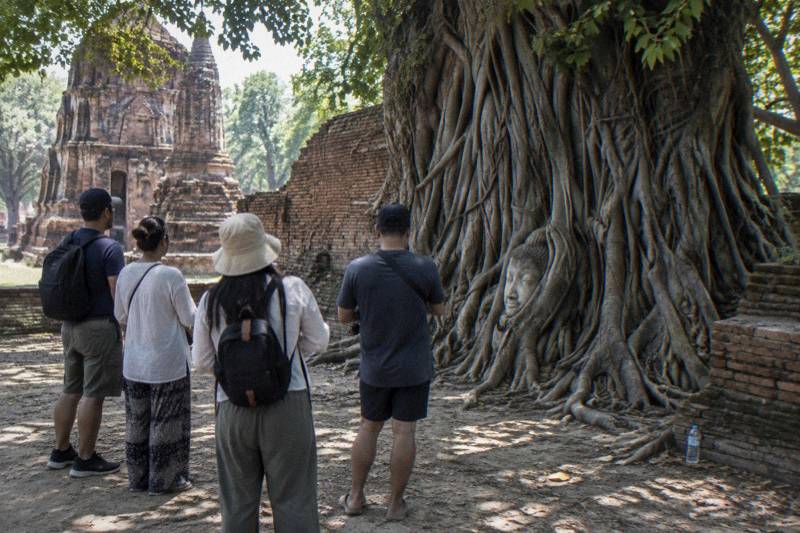
Ayutthaya is famous for the ruined temples of a sacked royal capital, the Buddha head grown into tree roots at Wat Mahathat, and the riverside prangs of a UNESCO World Heritage Site 76 km from Bangkok.
Ayutthaya is famous as the ruined royal capital of Siam, a city founded in 1351 and sacked in 1767, whose brick temples now stand roofless on a river island about 76 km north of Bangkok. Its UNESCO World Heritage listing in 1991 put the ruins on the world map, but the image most travellers carry is a single photograph: a stone Buddha head held in the roots of a fig tree at Wat Mahathat. If that photograph has already convinced you to visit, our guide to the best day trip from Bangkok makes the case for Ayutthaya and shows how to book it.
That photograph, and the sunset silhouette of Wat Chaiwatthanaram's prangs on the west bank of the Chao Phraya, do most of the work. But the fame has layers: a capital that traded with distant kingdoms, a skyline of chedis and prangs you can walk between for free, a river that surrounds the whole site, and a day-trip economy that makes it one of the most visited historical destinations in Thailand. This article unpacks each layer, drawn from the park's own record and the tours you can book today, and points to the tours that show the famous sights best.
What Is Ayutthaya Famous For?
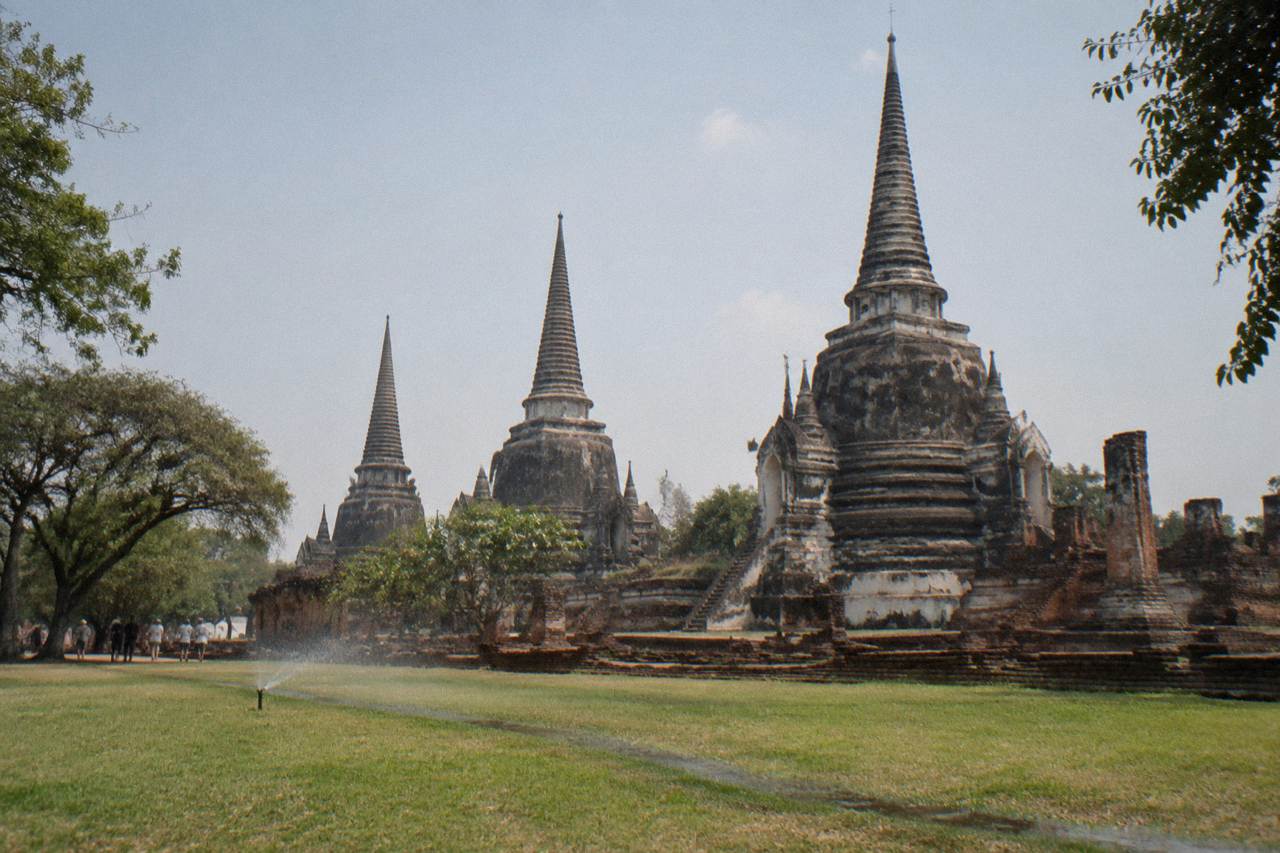
Ayutthaya is famous for the ruined temples of a royal Siamese capital founded in 1351 and destroyed by the Burmese army in 1767, inscribed by UNESCO in 1991. Its most recognised sights are the Buddha head grown into tree roots at Wat Mahathat, the triple chedis of Wat Phra Sri Sanphet, and the riverside prangs of Wat Chaiwatthanaram. That mysterious head entwined in the banyan roots has its own backstory, and the full history of the Buddha head in the tree at Wat Mahathat explains what historians believe happened when the city fell.
Those three images travel further than any statistic. The Buddha head in the roots appears in guidebooks, posters and social feeds worldwide; the site etiquette that comes with it, crouching or kneeling so your head sits lower than the Buddha's, is now as much a part of the visit as the photograph itself. The head is reached inside Wat Mahathat, the old royal temple compound at the heart of the park, and visitors are asked not to touch the roots.
The fame is also practical. The park grounds themselves cost nothing to enter: fees apply only at individual ticketed monuments, at 80 baht per site or 300 baht for the official seven-site ticket for foreign visitors, sold in cash at the gates with no online booking through official channels. The sites sit close together on flat ground, which is why the classic Ayutthaya experience is a slow circuit between ruins rather than one monument. For many visitors the circuit is done on a guided day trip from Bangkok, and the roster on this site reflects that: ten of the 21 listed tours are day trips from the capital, including the small-group full-day tour that visits Wat Mahathat, Wat Phra Sri Sanphet, Wat Chaiwatthanaram and Bang Pa-In Palace in one 11 hours 30 minutes outing. If you would rather make the trip independently, our step-by-step guide to traveling from Bangkok to Ayutthaya covers the train, minivan, and private driver options side by side.
The scale matters too. This is not one monument but a historical park spread across an island formed by three rivers, with dozens of temple sites in various states of ruin. Readers deciding how long to allocate should skim how much time you need in Ayutthaya, because the honest answer is that the famous highlights fit in one long day but the full island rewards two.
If you want the famous sites handled for you, these three tours cover the classic circuit in different formats:
The Temple Ruins You Can Still Walk Through
The fame is physical: roofless ordination halls, rows of headless Buddhas, leaning chedis and brick prangs you walk between on open ground. The park's core sites, including Wat Mahathat, Wat Phra Sri Sanphet and Wat Chaiwatthanaram, are open daily from 8am to 6pm, with foreign entry at 80 baht per site or 300 baht for the seven-site ticket.
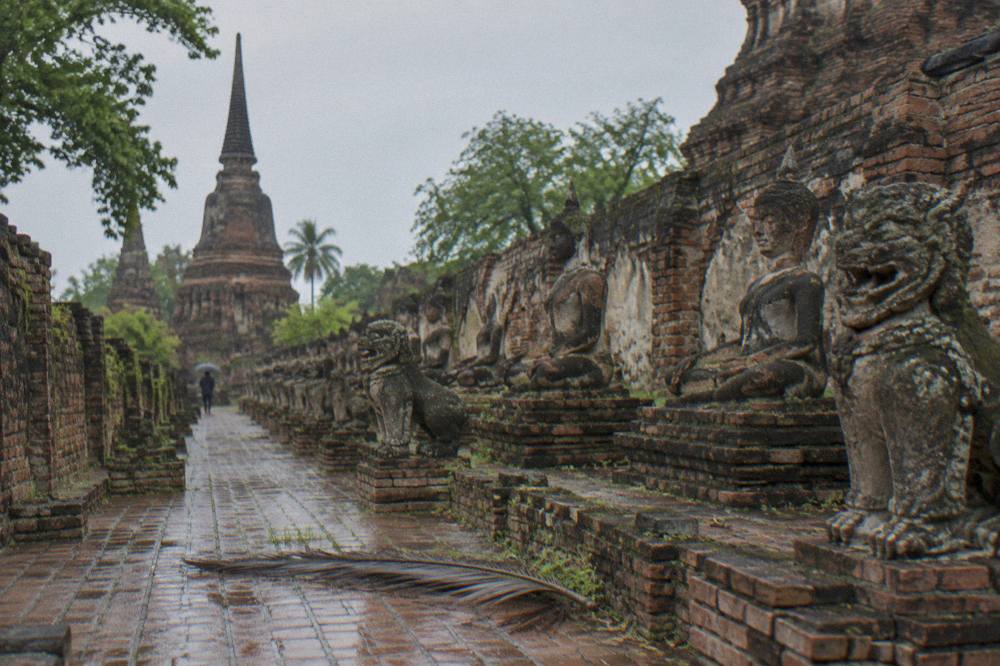
What surprises most first-time visitors is the texture of the place. The ruins are not fenced-off monuments viewed from a distance; you walk through broken gateways, past rows of Buddha images sitting in roofless niches, and around chedis that still carry stucco fragments after more than two and a half centuries of monsoon and sun. The Fine Arts Department administers the sites, and its official park page lists the hours and the foreigner fee structure that this site's verified facts mirror.
| Famous site | What it is known for | Entry for foreign visitors |
|---|---|---|
| Wat Mahathat | The Buddha head in the tree roots; the old royal temple precinct | 80 baht, or included in the 300 baht seven-site ticket |
| Wat Phra Sri Sanphet | Three great chedis of the royal palace precinct | 80 baht, or included in the seven-site ticket |
| Wat Chaiwatthanaram | Riverside prangs on the west bank; the classic sunset view | 80 baht, or included in the seven-site ticket |
| Wat Lokayasutharam | The giant reclining Buddha in the open air | Free |
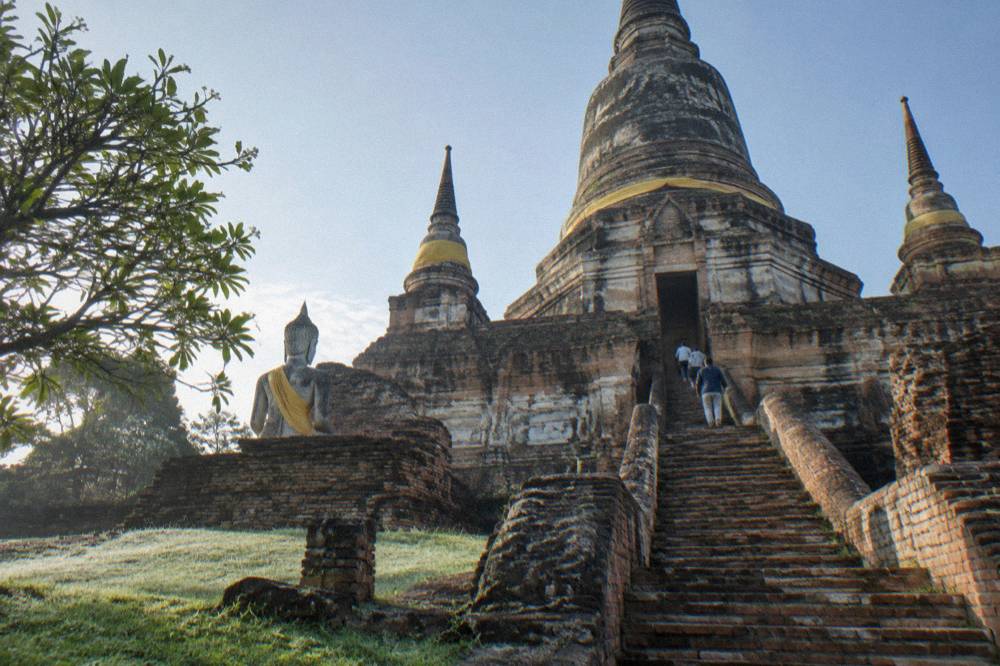
| Wat Yai Chai Mongkhon | Working monastery with a tall chedi and rows of seated Buddhas | About 20 baht, secondary guides |
Two things in that table deserve emphasis. First, the seven-site ticket is the official Fine Arts Department flat rate, and it covers exactly seven named monuments: Wat Phra Si Sanphet, Wat Phra Ram, Wat Mahathat, Wat Ratchaburana, Wat Chaiwatthanaram, Wat Maheyong and Wat Kudi Dao. Second, not everything famous is ticketed. The reclining Buddha at Wat Lokayasutharam, one of the most photographed objects in the city, is free to visit, and the riverside exterior views of Wat Chaiwatthanaram cost nothing.
The headless Buddhas have their own story, and it is one of the few pieces of history that is documented plainly: the city was sacked in 1767 by the Burmese army, and the destruction left the temples burned and the images broken. What you see now is the aftermath, stabilised and conserved rather than rebuilt, which is precisely why UNESCO inscribed the site in 1991 under criterion (iii), as an exceptional witness to a vanished civilisation. The official Fine Arts Department park map lists the sites and fees: the department's Ayutthaya park page.
Wondering which of the famous sites to fit into a single visit? The practical sequencing is covered in what to visit in Ayutthaya in one day, which pairs the headliners with realistic travel time between them.
The Buddha Head In The Tree Roots At Wat Mahathat
The single most famous sight in Ayutthaya is a stone Buddha head that fig-tree roots have grown around and lifted, now displayed inside Wat Mahathat behind a low barrier. Visitors are asked to crouch or kneel for photographs so their head sits lower than the Buddha's, and to avoid touching the roots.
How the head reached the roots is not settled by any reliable account, and this site keeps it that way: the files note the question but do not confirm a mechanism, so any confident story you read elsewhere should be taken with caution. What is verified is the etiquette and the fee. The head is inside the Wat Mahathat compound, a ticketed site at 80 baht for foreign visitors or covered by the 300 baht seven-site ticket, and the etiquette rules come from the site's own guidance: crouch or kneel, keep your head below the Buddha's, and leave the roots alone.
The photograph is genuinely worth the queue. The head sits at ground level, framed by pale roots, and the low crouch that etiquette demands happens to produce the best angle, which is part of why the image is so consistent across thousands of visitor photos. Go early: the spot is small, and midday tour groups form a line.
Wat Mahathat itself earns its place beyond the head. It was the old royal temple precinct, and its rows of headless images and broken laterite columns give the clearest single picture of what the 1767 destruction did to the city. If the story of the head interests you, this site covers the missing-head question in detail in why the Buddha head is missing in Ayutthaya.
Riverside Prangs And The Sunset Silhouette
Wat Chaiwatthanaram, on the west bank of the Chao Phraya across from the island, is the sunset icon: a central prang ringed by smaller towers, glowing gold at dusk and reflected in the river. It is a ticketed site at 80 baht, and its riverside position makes it the standard final stop of every sunset itinerary.
The prang silhouette is Ayutthaya's second famous image, and the reason sunset tours exist as a category. Four listings on this site's roster are boat and sunset tours, all running late afternoon into golden hour, none of them a night tour: the park's illumination happens only during announced events, not nightly, so "sunset" is the honest ceiling for late visits. The riverside exterior of Wat Chaiwatthanaram can be viewed for free from the water or the far bank, which is why shared longtail circuits, quoted by 2026 guides at roughly 200 to 300 baht per person, cluster there in the last hour of daylight.
The river is not decoration. The city sits on an island formed by the Chao Phraya, the Lopburi and the Pa Sak, and the water both protects and threatens the ruins. In the 2026 flood season the Fine Arts Department installed a 165-metre, 1.9-metre-high prefabricated barrier along the riverfront at Wat Chaiwatthanaram, and the site stayed open; the same season saw a 120-metre barrier at Wat Kasattrathirat. The pattern is recurring rather than catastrophic: riverside sites may restrict access when the water rises, and the park generally stays open year-round.
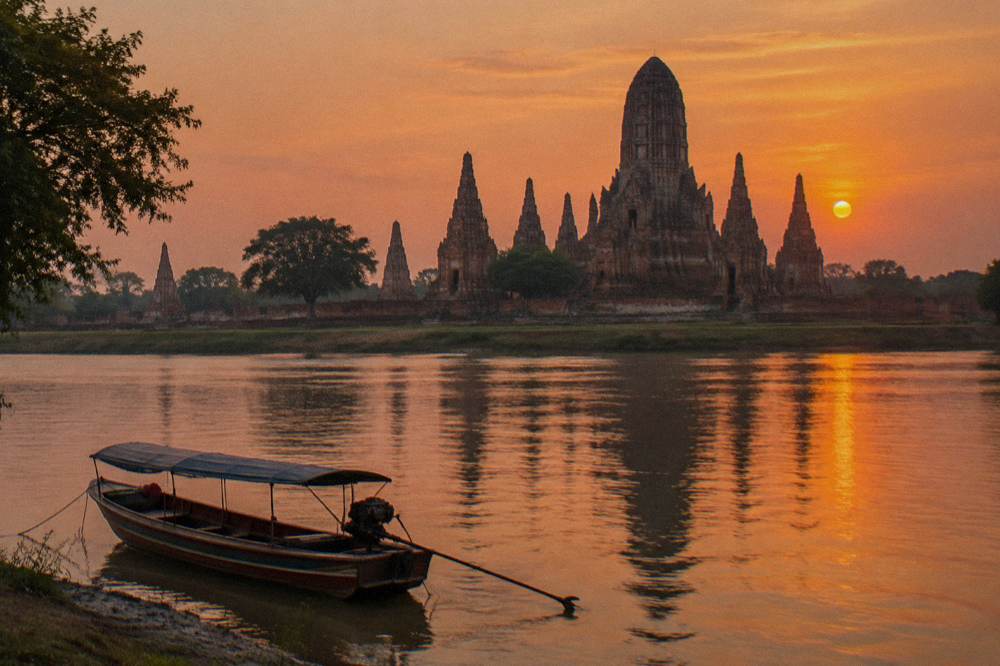
For visitors who want the sunset without organising boats themselves, the cruise-format day tours handle it: the Grand Pearl river cruise tour returns to Bangkok by boat, and the boat-and-temple experience tour pairs a vehicle out with a river ride. The dedicated sunset options are compared in the Ayutthaya sunset river cruise guide.
A Royal Capital Of Siam: The History Behind The Fame
Ayutthaya was founded in 1351 and served as the capital of Siam for over four centuries, growing into one of the wealthiest trading cities in Asia before the Burmese army sacked it in 1767. UNESCO inscribed the ruins in 1991 under criterion (iii), recognising the site as exceptional testimony to a vanished civilisation.
The verified dates are few and they are the ones that matter. Founded 1351, per the Fine Arts Department's own calculation commonly given as 4 March of that year. Sacked 1767. Inscribed 1991. Between those bookends, the city was a royal capital with a cosmopolitan trade life, and the physical evidence of that wealth is what you walk through now: palace precincts, monumental chedis built to hold relics and royal ashes, and temple compounds laid out on a scale that only a rich state could fund.
What the ruins preserve is unusual. Because the city was destroyed rather than continuously rebuilt, the site keeps its 1767 footprint. The brick core of each monument survives where the timber and plaster burned or rotted away, which is why so many structures stand as hollow shells: the permanent materials persisted, the rest did not. Conservation rather than reconstruction has been the rule since, which is why the site reads as an honest ruin.
For a comparison with the other famous ruined capital in Thailand, and how the two differ in scale and feel, see Ayutthaya or Sukhothai.
How To See The Famous Sights From Bangkok
The famous sites sit about 76 km from Bangkok, and the standard way to see them is a guided day trip with hotel pickup, of which the roster lists ten, ranging from a 6 hours 30 minutes group outing to an 11 hours 30 minutes small-group circuit. All listed day trips include free cancellation, and pickup from central Bangkok hotels is stated on most.
The day-trip format dominates for a reason: the sites are close together, the stories need a guide to land, and self-driving adds parking and heat-management problems you avoid in an air-conditioned van. The full-day small-group tour run by TripGuru Thailand is the flagship option, 11 hours 30 minutes with a maximum of 9 travellers, covering Wat Mahathat, Wat Phra Sri Sanphet, Wat Chaiwatthanaram and Bang Pa-In Palace, with central hotel pickup stated and a 4.7 rating from 1,728 reviews. It is the tour this article's readers most often compare against, and you can check the full-day UNESCO park tour directly.
| Format | Example from the roster | Duration | Group size |
|---|---|---|---|
| Small-group full-day tour | UNESCO Ayutthaya Historical Park full-day tour | 11 hours 30 minutes | Max 9 |
| Group tour with lunch | Ayutthaya Temples Tour from Bangkok with Lunch | 7 hours 30 minutes | Max 25 |
| Boat-and-temple experience | Bangkok: Ayutthaya Experience with Boat Ride and Tickets | 8 hours | Group, private option |
| Private guided day tour | Ancient City UNESCO Heritage private day tour | 8 hours | Private |
| Full-day bike tour | Colors of Ayutthaya Full-Day Bike Tour | 6 hours | Max 15 |
Each format shows the famous sites through a different lens. The temples-with-lunch tour run by Bigcountry Experience compresses the circuit into 7 hours 30 minutes for up to 25 travellers, with lunch included per the listing and a 4.7 rating from 867 reviews, which suits visitors with an afternoon flight or a tight schedule.
The bike format suits a different traveller entirely. The park is flat and compact, and the full-day bike tour run by ThailandBiking covers the reclining Buddha, Wat Phra Sri Sanphet, Wat Mahathat, Wat Chaiwatthanaram and Wihan Phra Mongkhon Bophit in 6 hours with a maximum of 15 riders, lunch included, at a 4.8 rating from 66 reviews. It is the format that gets you between the famous sites at ground level, feeling the distances rather than watching them through glass.
For a shorter ride focused on the island itself, the city and historical park bike tour run by Recreational Bangkok Biking runs 3 to 3.5 hours with a private group option and a 4.8 rating from 188 reviews, which pairs well with a morning arrival by train. The heat question is real and addressed in is an Ayutthaya bike tour hard in the heat.
Independent travel is equally workable, and the train option has improved: the air-conditioned commuter service from Krung Thep Aphiwat launched in August 2026 covers the distance in about 1 hour 15 minutes, with promotional fares capped at fifty baht through the current promotion, and ordinary third-class trains run from about 15 to 20 baht. The trade-offs between train and tour are laid out in Bangkok to Ayutthaya by train or tour, and the budget angle, including free sites and 20-baht boat noodles, is covered in the free and budget things to do guide.
Whichever format fits, the underlying advice from Ayutthaya Historical Park Tours is the same: the famous sites are close together, the official fees are 80 baht per site or 300 baht for the seven-site ticket in cash, and the midday heat is the one variable no itinerary forgives, so start early and put Wat Chaiwatthanaram last.
If you are still choosing a format, these are the three tours that best cover the famous circuit:
Common Questions About What Ayutthaya Is Famous For
What Is Ayutthaya Famous For?
Ayutthaya is famous for the ruined temples of a royal Siamese capital founded in 1351 and sacked by the Burmese army in 1767, now a UNESCO World Heritage Site listed in 1991. Its most recognised sights are the Buddha head grown into tree roots at Wat Mahathat, the triple chedis of Wat Phra Sri Sanphet and the riverside sunset prangs of Wat Chaiwatthanaram.
Is Ayutthaya A UNESCO World Heritage Site?
Yes. The Historic City of Ayutthaya was inscribed on the UNESCO World Heritage List in 1991, under criterion (iii), as exceptional testimony to a vanished civilisation. The listing covers the temple ruins on and around the old island capital.
How Much Does It Cost To See The Famous Temples?
The park grounds are free to enter. Foreign visitors pay 80 baht at each ticketed monument, or 300 baht for the official seven-site ticket covering Wat Phra Si Sanphet, Wat Phra Ram, Wat Mahathat, Wat Ratchaburana, Wat Chaiwatthanaram, Wat Maheyong and Wat Kudi Dao. Tickets are sold in cash at the gates; there is no advance online booking through official channels.
Why Is The Buddha Head In The Tree Roots Famous?
The stone head at Wat Mahathat has been lifted and framed by the roots of a fig tree, creating one of the most photographed images in Thailand. Visitors are asked to crouch or kneel so their head sits lower than the Buddha's and not to touch the roots. How the head reached the roots is not settled by any reliable account.
Can You See The Famous Sites In One Day?
Yes. The headline sites, Wat Mahathat, Wat Phra Sri Sanphet, Wat Chaiwatthanaram and the reclining Buddha at Wat Lokayasutharam, fit into one long day, and most guided day trips from Bangkok run 6 hours 30 minutes to 11 hours 30 minutes. Two days reward visitors who want to add Bang Pa-In Palace or the west-bank temples.
Are The Temples Lit Up At Night?
Not on a nightly basis. Evening illumination at the major temples happens only during announced event periods, such as the cool-season lighting series, so a standard visit ends at sunset. The listed sunset tours run late afternoon into golden hour and are not night tours.