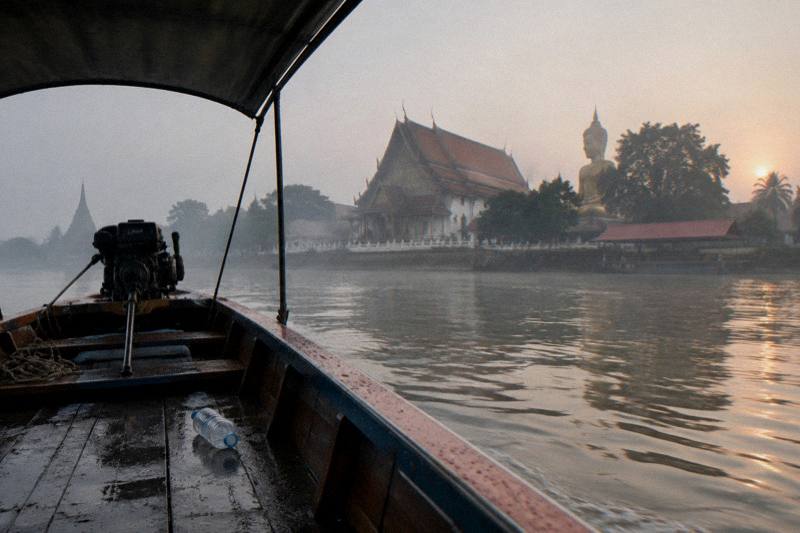
Wat Chaiwatthanaram At Sunset
Wat Chaiwatthanaram sits on the west bank of the Chao Phraya, and its Khmer-style prangs catch the last light of the day better than any other monument in Ayutthaya. This guide covers when to arrive, where the light falls, and how the 2026 flood season affects a visit.
Short answer
Wat Chaiwatthanaram is open 8:30 to 18:30, with no ticket sales after 18:30, and foreign visitors pay 80 baht at the gate or use the 300 baht seven-site combo ticket. Arrive an hour to an hour and a half before sunset to see the prangs glow from the east bank, then cross for the interior.
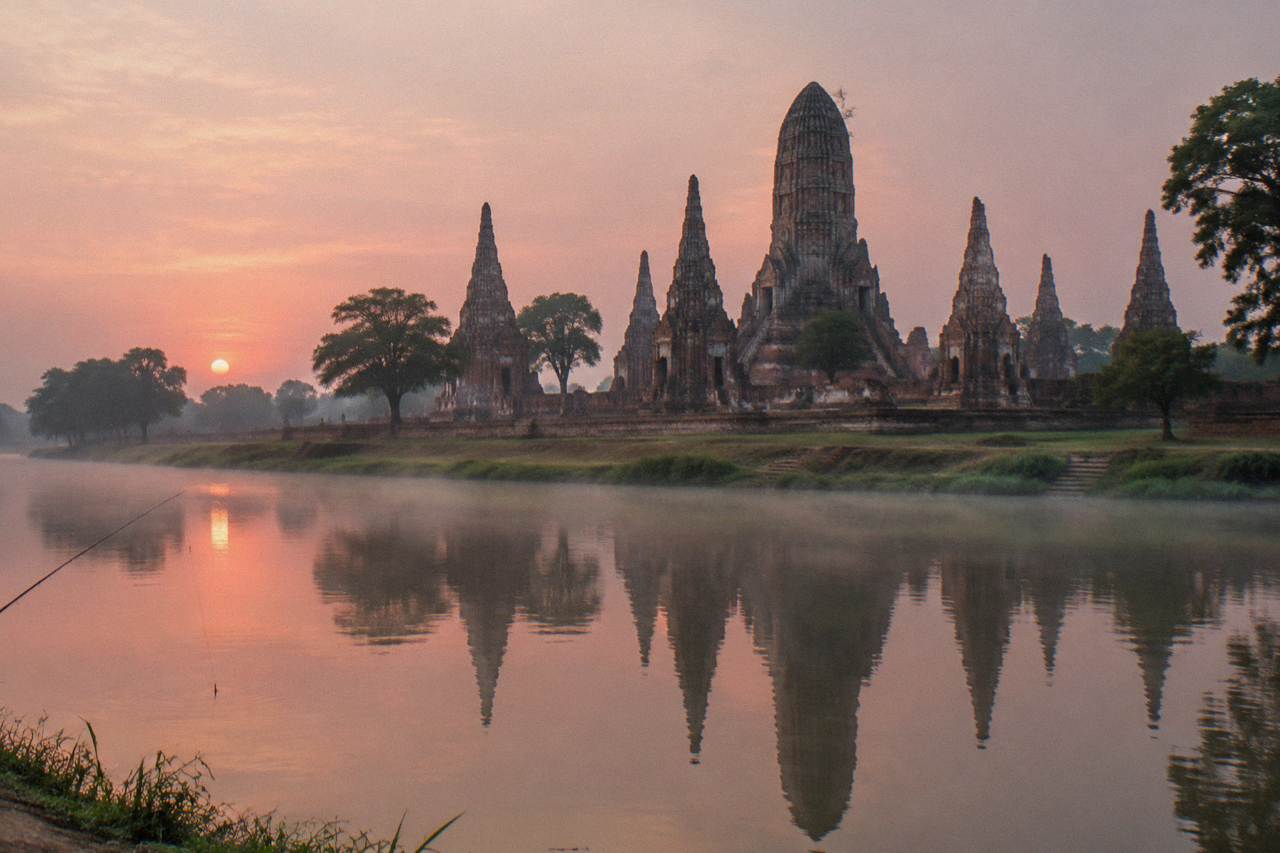
Wat Chaiwatthanaram is the monument most sunset plans in Ayutthaya are built around, and the reason is geography. The temple stands on the west bank of the Chao Phraya river, facing back across the water toward the old city island, and its central prang rises above a line of smaller towers in the classic Khmer style. When the sun drops behind the temple, the brick faces catch an orange glow that photographers cross the river for. When you stand on the east bank looking west, you get the silhouette. When you stand inside the grounds, you get the light raking across the brick.
The temple is one of the seven sites on the official combination ticket, so most visitors arriving by tour or on their own will pay the standard foreigner fee at the gate. The practical details matter more here than at almost any other monument in the park, because the closing routine is tied to the light. Ticket sales stop after 18:30, and the best photographs happen in the last hour of daylight, which in Thailand falls remarkably close to that cutoff for much of the year. This guide walks through the timing, the light, the ways to see it, and the one thing that has changed recently: the flood barrier installed along the riverfront during the September and October 2026 high-water season.
What Makes Wat Chaiwatthanaram The Sunset Temple?
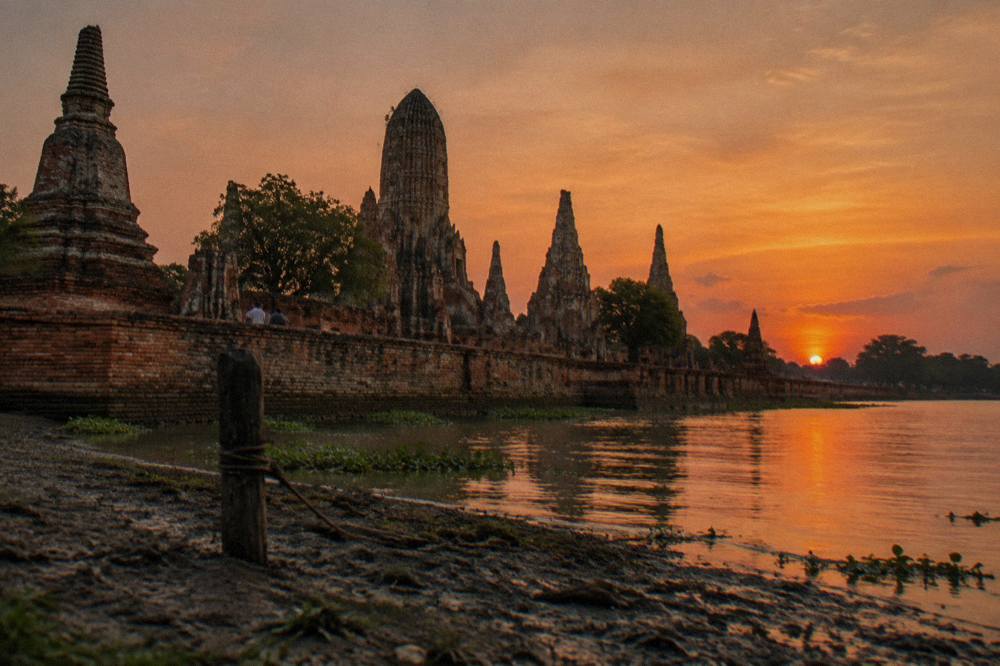
Wat Chaiwatthanaram earns its sunset reputation through a rare combination of west-bank placement, a tall central prang ringed by smaller towers, and an unbroken river view, which together produce a silhouette from the east bank and a warm brick glow from inside the grounds. No other major monument in the historical park sits across the river from the island with its main mass facing the water. That position is what the sunset boat circuit exists to exploit: a vessel on the Chao Phraya in the last hour of daylight passes the temple front on, with the prangs stacked against the sky. The private longtail boat tour to historic temples lists Wat Chaiwatthanaram first among its stops, alongside Wat Phanan Choeng and Wat Kasattrathirat, and the sunset heritage tour from Bangkok builds its final hour around a boat ride timed to the same light.
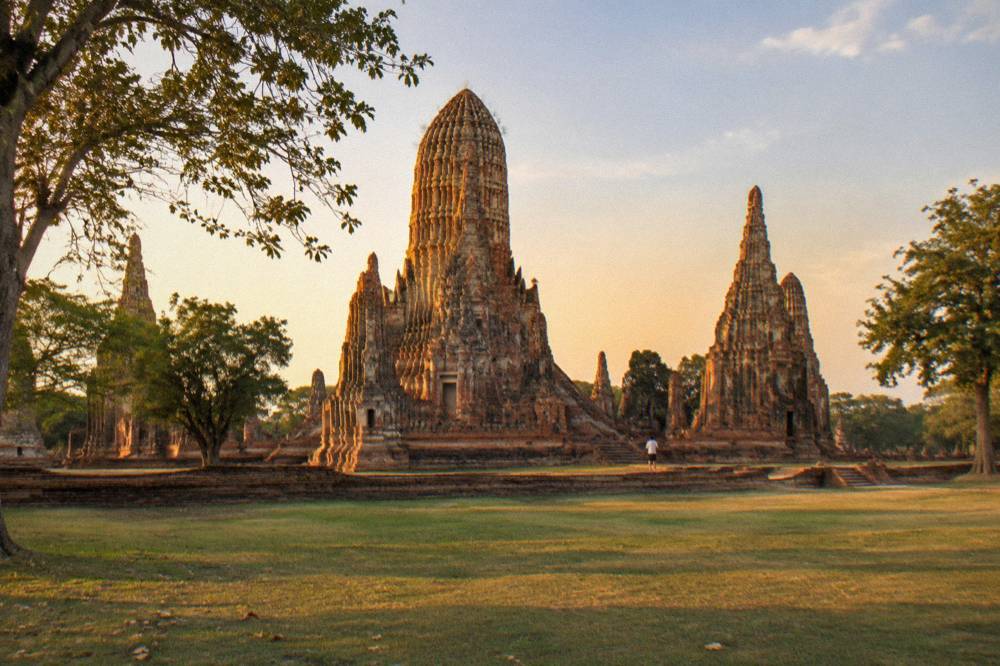
The architecture does the rest. The temple was laid out in the Khmer tradition, a central prang surrounded by eight smaller ones on a platform, with a line of chedis stretching toward the river. Late sun strikes the eastern faces of those towers first, then as the angle drops the glow spreads across the whole mass. Visitors who arrive at midday often leave underwhelmed by flat, hot brick; visitors who arrive at 17:00 see the same structure transformed. The contrast is the single most common note in guest reviews of the sunset listings, several of which describe the final stop as the moment the day trip earned its cost.
There is a second, quieter reason the temple owns the sunset slot: the grounds are large enough to absorb crowds. The platform and the riverside lawn spread people out, so even on a busy evening the temple rarely feels as congested as the Buddha head enclosure at Wat Mahathat, which most tours visit earlier in the day. If your plan is a full circuit of the island's ruins, saving Chaiwatthanaram for last is both the photographic logic and the crowd logic, and the temples Ayutthaya tours visit guide covers how the standard circuit is sequenced.
When Should You Arrive For Sunset At Wat Chaiwatthanaram?
Arrive an hour to an hour and a half before local sunset, which usually means reaching the gate between 16:30 and 17:00, because ticket sales stop after 18:30 and the best light comes in the final hour; in the cool season this window is comfortable, in March to May it is still hot. The temple's listed hours run 8:30 to 18:30, with no ticket sales after 18:30, and the official park hours run 8:00 to 18:00 daily. Those two schedules sit close together, and sunset in central Thailand falls roughly between 17:50 in December and 18:30 in mid-year, so for much of the year the last saleable minutes and the best light overlap almost exactly.
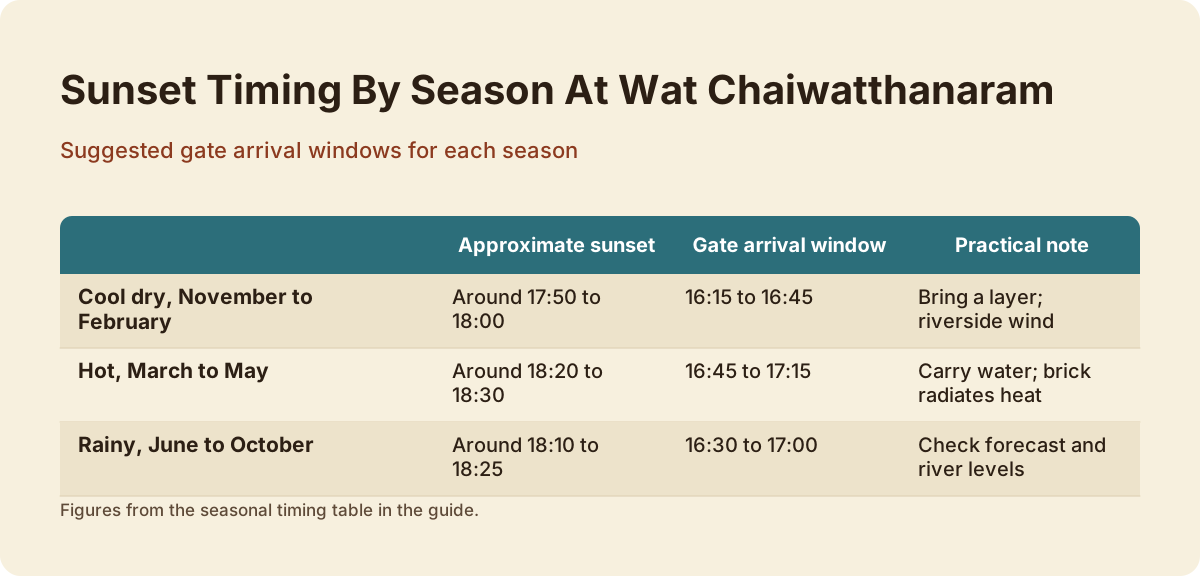
The arithmetic is worth doing before you set out. If sunset is at 18:00, you want to be through the gate by 16:30 at the latest. That gives you time to walk the outer chedis while the sun is still up, find your angles on the platform, and be positioned on the east side or across the river for the final glow. If sunset is at 18:25, you have a more generous window, and you can afford a slow loop of the grounds. The table below turns the general rule into a plan for the three seasons.
| Season | Approximate sunset | Suggested gate arrival | What the light does | Practical note |
|---|---|---|---|---|
| Cool dry, November to February | Around 17:50 to 18:00 | 16:15 to 16:45 | Fast, warm glow; sky clears quickly after the sun drops | Bring a layer; riverside wind picks up after dusk |
| Hot, March to May | Around 18:20 to 18:30 | 16:45 to 17:15 | Long harsh light, then a quick softening in the last 20 minutes | Carry water; the brick radiates heat until close |
| Rainy, June to October | Around 18:10 to 18:25 | 16:30 to 17:00 | Best color after a passing shower; cloud can kill the glow entirely | Check the forecast and river conditions before crossing |
Two timing traps catch visitors every week. The first is assuming a tour will handle the cutoff for you: several day trips from Bangkok that list the temple arrive in early afternoon, well before the golden hour, because their itinerary has to fit the boat ride or the return drive. If golden-hour light is the point of your visit, check the itinerary's stated per-stop times on the listing before booking, and favor the tours that name a sunset boat ride or a late-afternoon temple stop. The second trap is the return journey: after the gates stop selling tickets, transport across the river thins out, and if you came by rented bike you will be riding back in the dark. The best time of day to visit Ayutthaya article unpacks the broader daylight logic for the whole park.
For travelers who would rather hand the timing to an operator, three listings are built around this exact window. The sunset heritage tour from Bangkok runs 6 to 7 hours with hotel pickup and a one-hour sunset boat ride, rated 4.6 from 687 reviews. The UNESCO temples and peaceful sunset cruise tour runs a full 8 hours with a traditional boat ride, rated 4.4 from 368 reviews. The private longtail boat tour, rated 4.6 from 121 reviews, lets you set your own departure within its 50-minute to 4-hour range.
What Are The Best Ways To See The Temple At Golden Hour?
The four proven ways are an organized sunset boat tour, a private longtail charter, a rented bike ridden to the east bank viewpoint, and a tuk-tuk or private car circuit timed to arrive an hour before sunset; the boat options put you on the water for the reflection, the land options put you inside the grounds for the glow. Each suits a different budget and a different kind of traveler, and the choice mostly comes down to whether you want the temple in silhouette or in detail.
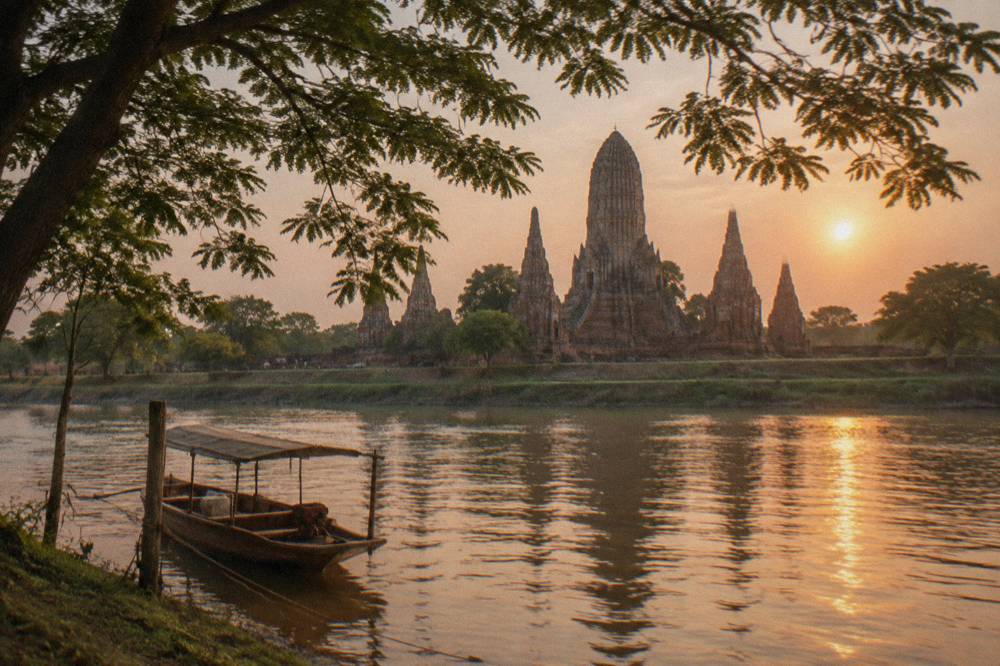
The boat options dominate for good reason. From the water you see the full riverfront face of the temple, all eight satellite prangs in a line, and on a calm evening the reflection doubles the composition. The Ayutthaya sunset river cruise guide compares the cruise-style options in detail, but the short version is this: the organized sunset tours bundle the boat with temple visits and Bangkok pickup, while the private longtail charter is bought by the boat, departs from a riverside pier, and can linger as long as you pay for. 2026 guides quote shared longtail circuits at roughly 200 to 300 baht per person and private boats at roughly 1,000 to 2,000 baht per group, figures worth confirming on the pier before you board.
The land options suit travelers staying in Ayutthaya overnight or arriving independently. A rented bike, roughly 50 to 100 baht a day per 2026 guides, gets you to the east bank viewpoint across the bridge, which is where the classic silhouette photograph is taken. A tuk-tuk charter, roughly 400 to 600 baht for a half day per the same guides, lets you string the sunset stop onto a wider circuit. The bike-based option deserves special mention: the 3-hour sunset ride bike excursion, rated 4.8 from 37 reviews, is a small listing with a small review pool, but it is the one product on the roster explicitly designed around riding through the park as the light drops.
| Way to see it | Where you watch from | Best for | Main tradeoff |
|---|---|---|---|
| Organized sunset boat tour | River, passing the temple front | Day trippers from Bangkok who want everything handled | Fixed itinerary and group pace |
| Private longtail charter | River, at your own speed | Photographers and families who want to linger | Price scales with boat time |
| Rented bike to the east bank | Bridge viewpoint across the river | Independent travelers on a budget | You ride back after dark |
| Tuk-tuk or private car circuit | Inside the grounds | Visitors combining several temples in one evening | Traffic on the bridge road at peak |
The sunset heritage tour is the most direct package of the lot for Bangkok-based visitors: hotel pickup, a run through Wat Yai Chai Mongkhon, Wat Mahathat and Wat Chaiwatthanaram, then the one-hour boat ride as the light comes down, with free cancellation if your plans shift.
The same operator family also runs a group sunset cruise variant, so if the heritage tour's small-group format is full on your date, the 8-hour sunset cruise tour with its group of up to 22 covers the same ground at a different pace.
Where Does The Light Fall Through The Ruins?
The sun sets behind the temple to the west, so the eastern faces of the prangs light up first in the late afternoon, and the strongest photographs come from the east bank looking west at the silhouette, or from the platform looking back at the river with the glow behind you. Inside the grounds, the practical choreography is simple: start on the eastern edge of the complex in the hour before sunset, when the low sun rakes across the brick and throws long shadows from the satellite towers, then work toward the river as the sky warms.
The central prang is the anchor for almost every composition. Its eastern face catches the last direct light, and the eight smaller towers around it create layered silhouettes as the sun drops. The line of chedis on the river side of the complex frames the water, and from a boat those chedis are what you see first, which is why the cruise itineraries time their pass for the final stretch of the ride. If you are on land and mobile, Wat Phu Khao Thong, outside the main island and reachable by tuk-tuk or songthaew, offers elevated views over the fields and is a genuine alternative for a sunset panorama, though it is a different photograph entirely: distance and height rather than river and reflection.
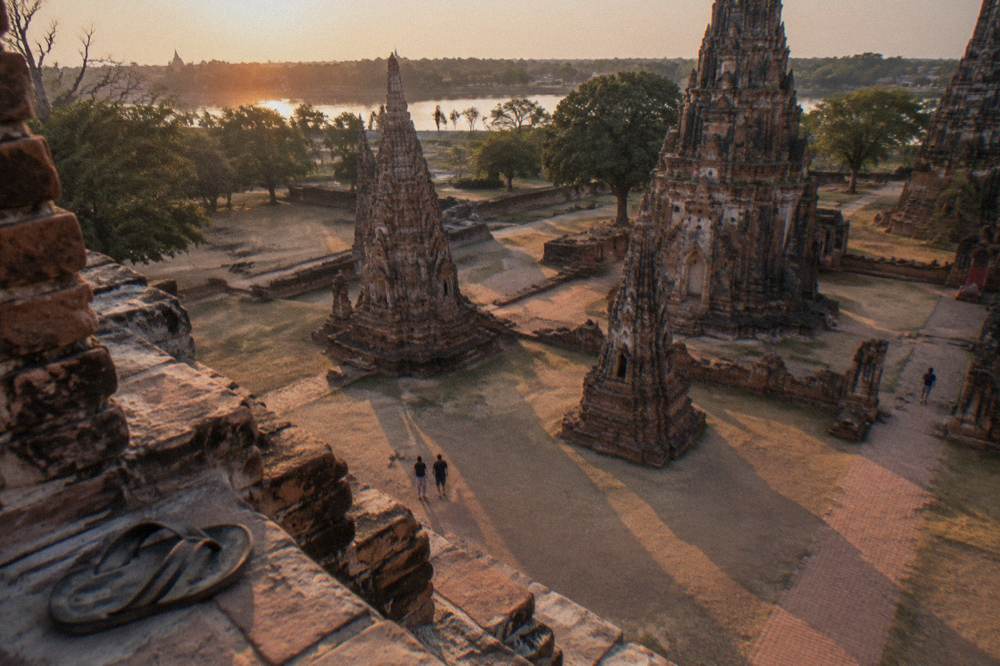
The numbers behind the timing are worth seeing side by side, because they explain why the window feels so tight. The chart below shows how the key clock times stack up against each other through the year.
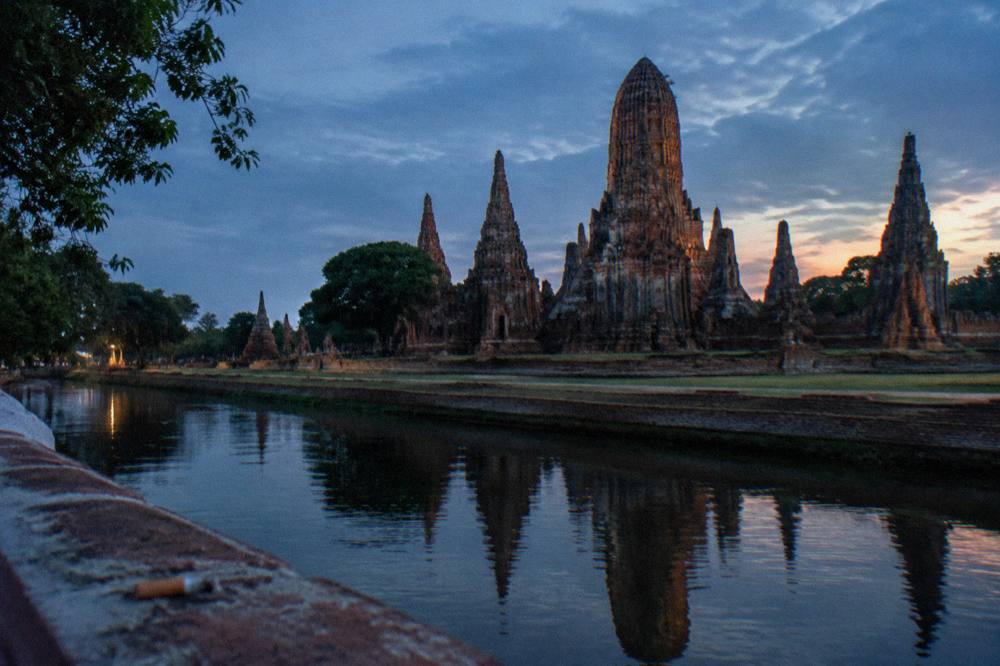
One compositional note that first-time visitors miss: after the sun drops below the horizon, the sky behind the temple keeps its color for another 10 to 15 minutes, and the grounds do not empty the moment the light goes. The no-ticket-sales-after-18:30 rule governs entry, not immediate expulsion, so visitors already inside routinely get the afterglow. The blue-hour frames, brick towers against a deepening sky, are arguably the best of the evening, and they cost nothing extra. The bike-based sunset excursion exists precisely to serve this stretch of the evening, riding between monuments as the light changes rather than standing still for it.
How Does The 2026 Flood Barrier Affect A Visit?
During the September to October 2026 high-water season the Fine Arts Department installed a 165-metre, 1.9-metre-high prefabricated flood barrier along the temple's riverfront, with a 120-metre barrier at Wat Kasattrathirat nearby, and the temple remained open to visitors throughout, so the main practical effect is on the riverside foreground rather than access itself. The barrier is a functional structure, not a scenic one, and photographers who planned on the classic lawn-and-water foreground have found steel and sandbags in the frame instead. The reported details of the installation describe it as a temporary flood-protection measure, and the same reporting confirmed the site stayed open.
The wider context is the Chao Phraya's annual rise. September is statistically the wettest month and October carries the peak flood risk, and in 2026 upstream dam releases pushed river levels up across the province, affecting low-lying districts outside the historical island. The core park monuments reported no closures, but riverside sites can restrict access temporarily when water climbs, and the practical advice is to check conditions locally on the day. If your sunset plan depends on the riverfront lawn or a boat departure, a quick look at the water level on the day matters more in these two months than in any others. Other pages covering the same trip are gathered on Ayutthaya Historical Park Tours.
For tour bookings this cuts both ways. On one hand, flood-season disruption is exactly the kind of thing that makes free cancellation valuable, and every listing on this site's roster carries it. On the other hand, the operators that run boats every evening are the fastest to know whether a departure is viable, so if the river is high and you are booked on a sunset boat tour, expect the operator to be the one making the call, sometimes on short notice. The general seasonal picture, including which months pair clear skies with comfortable temperatures, is laid out in the best time to visit Ayutthaya guide; the short version for this temple is that November to February gives the most reliable sunsets, and the post-monsoon November skies are a quiet sweet spot before the December and January crowds.
Is Wat Chaiwatthanaram Open Or Lit Up After Dark?
No, the temple is not a nightly night attraction: evening illumination happens only during announced events or festival periods, and outside those windows the grounds go dark after closing, so a visit should be planned around natural golden-hour light rather than any permanent lighting scheme. This is the single most common planning mistake around the temple. Travelers hear "sunset temple" and assume floodlights follow, and some secondary content online encourages the idea with photographs taken during special lighting seasons. The Fine Arts Department has run evening lighting and performance programs in past seasons, for example the lighting events that ran on weekend evenings from December 2025 into February 2026, but those are scheduled occasions, not a standing feature, and the way to know is to check announcements for your dates rather than assume.
The distinction matters for tour selection too. No listing on this site's roster is a night tour, and none should be booked expecting one. The sunset listings run late afternoon into golden hour: the heritage tour's boat ride is one hour on the water timed to the light, the sunset cruise tour's traditional boat ride occupies the final stretch of its 8-hour day, and the longtail charter is a daylight product with a flexible end time. What they deliver is the glow, the silhouette and the afterglow, all of which happen before true dark.
If your heart is set on illuminated prangs, the honest answer is to time a visit to a festival period. Loy Krathong falls on Tuesday 24 November 2026, and it is the one date on the calendar when candlelight, floating krathongs and temple lighting plausibly coincide, though specific illumination schedules are announced closer to such events rather than published far ahead. Outside those windows, the afterglow described in the light section above is the best the evening offers, and it is genuinely good.
What Should You Check Before You Go?
Check five things: the sunset time for your date, the day's river level if you are visiting in September or October, your cash for the gate, whether any lighting event is announced, and your route back after dark, because the gate takes cash only and there is no advance online booking for temple tickets. The temple entry fee for foreign visitors is 80 baht per site, and the official seven-site combination ticket is 300 baht, sold at the first included site; the official Fine Arts Department page lists both. Wat Chaiwatthanaram is one of the seven sites on that ticket, so if your day already includes Wat Mahathat or Wat Phra Sri Sanphet, the combo ticket is the cheaper route.
| Item to check | Where to check | Why it matters |
|---|---|---|
| Local sunset time | Any weather app for Ayutthaya | Sets your gate arrival an hour to an hour and a half ahead |
| River level and access | Local news or your tour operator, in Sep to Oct | Riverside sites can restrict access when water climbs |
| Cash for tickets | ATM before crossing the bridge | Gates take cash; no online booking exists |
| Lighting or festival announcements | Fine Arts Department or tourism announcements | Illumination runs only during announced events |
| Return transport after dark | Your bike lamp, tuk-tuk stand or tour vehicle | Services thin out after the gates close |
Dress and etiquette round out the list. Shoulders and knees covered is the standing rule at Thai temples, and while the ruins are open-air, the site is treated with the same respect as an active temple. The Buddha head at Wat Mahathat, which most itineraries pair with this temple, carries its own etiquette: crouch or kneel so your head sits lower than the head in the roots, and do not touch. The what to wear to Ayutthaya temples guide covers the clothing side in full, and it is worth reading before a hot-season visit, when the temptation to strip down to shorts fights directly with the dress code.
For visitors who prefer to fold all of this into a single booking, the day-trip listings handle the logistics and leave only the personal checks to you. The Bangkok Ayutthaya experience with boat ride and tickets, rated 4.9 from 861 reviews, runs 8 hours with hotel pickup, an air-conditioned vehicle and a river boat, and a private group option exists for those who want the format to themselves.
How Do You Fit The Temple Into A Day Trip?
The pattern that works is a westward drift through the day: island ruins such as Wat Mahathat and Wat Phra Sri Sanphet in the morning and early afternoon, then cross the river for Wat Chaiwatthanaram last, so the itinerary ends on the best light rather than on the midday heat. Most organized tours already follow this sequence in some form, because it is the only order that makes photographic sense. The full-day small-group tour from Bangkok, rated 4.7 from 1,728 reviews, visits Wat Mahathat, Wat Phra Sri Sanphet, Wat Chaiwatthanaram and Bang Pa-In Palace over 11 and a half hours with a maximum of nine travellers, and its timing places the riverside temple comfortably into the late afternoon.
Independent travelers have more flexibility and one more decision: where to be when the sun drops. Staying inside the grounds gives you the glow on the brick; crossing to the east bank gives you the silhouette; being on the water gives you the reflection. You cannot be in all three places at once, and travelers who try to shuttle between them in the final 20 minutes usually end up in none. Pick one, commit, and let the other two be next time. The how to get around Ayutthaya article compares the bike, tuk-tuk and tour options for exactly this kind of split-day plan.
Overnight visitors get the best version of the plan. An evening at the temple, dinner in the town, and a morning return to the island's big three before the day-trippers arrive from Bangkok is the itinerary repeat visitors converge on. The town's food is part of the draw: boat noodles start from about 20 baht a bowl at the canal-side stalls, and an unhurried dinner after the afterglow is a better ending to a temple day than a highway back to the capital. For most first-time visitors, though, the day trip is the practical shape, and the small-group full-day format is the most complete single booking on the roster.
Whichever way you assemble the day, the constant is the temple's position at the end of it. Ayutthaya has no shortage of ruins, but it has exactly one that faces the sunset across open water, and every plan that puts you in front of it in the final hour of daylight is a plan that ends well. The listings below cover the three formats that do exactly that, from the packaged sunset boat tour to the private charter that lets you stay on the water until the afterglow fades.
Common Questions About Wat Chaiwatthanaram At Sunset
What time does Wat Chaiwatthanaram stop selling tickets?
Ticket sales stop after 18:30. The temple's listed hours run 8:30 to 18:30, and the official park hours run 8:00 to 18:00 daily, so plan to be through the gate well before the cutoff, ideally an hour to an hour and a half before sunset.
How much does it cost to enter Wat Chaiwatthanaram?
Foreign visitors pay 80 baht per site, or 300 baht for the official seven-site combination ticket, which includes Wat Chaiwatthanaram alongside Wat Phra Si Sanphet, Wat Mahathat and four other monuments. Tickets are sold on site in cash; there is no advance online booking.
Can you see Wat Chaiwatthanaram at night?
Not as a standing attraction. Evening illumination happens only during announced events or festival periods, not nightly, and outside those windows the grounds go dark after closing. Sunset listings run late afternoon into golden hour, not after dark.
Is Wat Chaiwatthanaram open during the 2026 flood season?
Yes. Despite rising Chao Phraya levels in September and October 2026, the temple remained open, protected by a 165-metre, 1.9-metre-high flood barrier along the riverfront. Riverside sites can restrict access temporarily when water climbs, so check conditions on the day.
Which tour gives the best sunset view of the temple?
The sunset heritage tour from Bangkok pairs the temple circuit with a one-hour sunset boat ride, rated 4.6 from 687 reviews. A private longtail charter, rated 4.6 from 121 reviews, offers more control over timing and can linger on the water through the afterglow.
Where is the best place to photograph the temple at sunset?
From the east bank across the river you get the classic silhouette of the prang line against the sky; from inside the grounds you get the warm glow on the eastern brick faces; from a boat you get the reflection. Pick one and commit for the final hour of light.