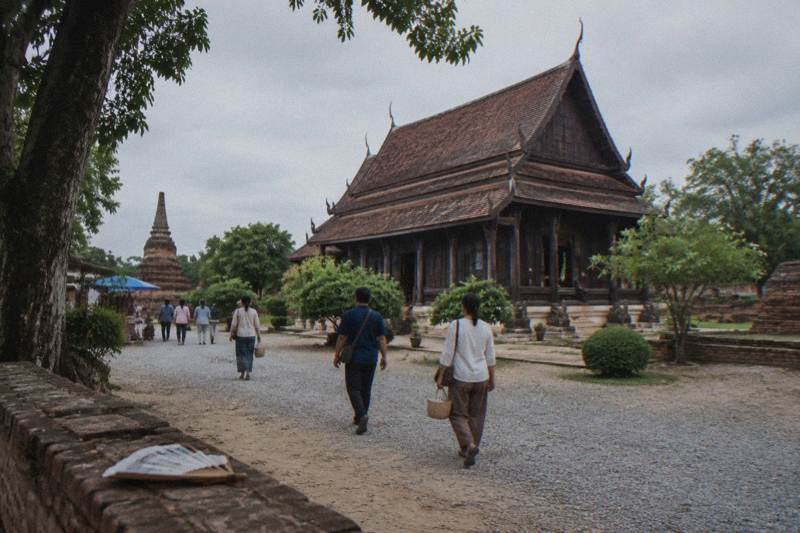
Ayutthaya Or Sukhothai
Thailand has two great ruined capitals, and most Bangkok travellers only have time for one. Here is how the choice actually breaks down when you look at distance, cost and what a day at each park feels like.
Short answer
For a Bangkok-based trip, Ayutthaya is the practical pick: about 76 km away, reachable in roughly 1 hour 15 minutes by the new air-conditioned commuter train, with a 300 baht seven-site ticket and a deep bench of day tours. Sukhothai rewards travellers already heading north, but it is not a comfortable day trip from Bangkok.
Thailand's two great ruined capitals sit at opposite ends of the traveller's map. Ayutthaya, founded in 1351 and sacked by the Burmese army in 1767, lies about 76 km north of Bangkok, close enough that the ruins have become the standard day trip out of the capital. Sukhothai, the older kingdom further north, tends to appear on itineraries that already include Chiang Mai. Most visitors to Bangkok have one spare day, not two, so the question is not which park is objectively better but which one fits the trip you are actually taking.
This site covers Ayutthaya in depth, and this guide covers Ayutthaya in detail, while Sukhothai stays general and hedged, because a fair comparison does not need invented numbers. What follows is what the record supports: distance, official fees, tour options and the shape of a day at each park.
Which Is Easier To Reach From Bangkok?
Ayutthaya wins the journey hands down. It sits about 76 km from Bangkok, and since 1 August 2026 an air-conditioned commuter train has covered the run in roughly one hour and fifteen minutes from Krung Thep Aphiwat station, with the promotional fare capped at fifty baht through 31 October 2026. Sukhothai lies far to the north, roughly an overnight journey from the capital, which rules it out as a day trip.
The train is the headline change for Ayutthaya. The Bangkok Connex service runs daily with counter tickets and unreserved seats, and the promotional fare is capped at fifty baht each way through the end of October 2026; the operator has not published what the fare becomes afterwards. About sixteen regular trains also connect the two cities each day, with ordinary third-class fares from about fifteen to twenty baht. Minivans take about one to one and a half hours and cost roughly sixty to one hundred baht, and a taxi or ride app runs roughly 900 to 1,500 baht one way according to 2026 guides.
Sukhothai, by contrast, is a destination you plan a route around. Travellers typically reach it by overnight train or bus toward the north, or by flying into a northern hub and doubling back. The practical consequence is simple: if your base is Bangkok and your free time is a single day, Sukhothai is not on the menu. It becomes the right answer only when your itinerary already points north.
Because the journey is this easy, Ayutthaya has grown a large commercial tour scene, and the quality spread shows in the review counts. The small-group full-day tour run by TripGuru Thailand, rated 4.7 from 1,728 reviews, picks up at central Bangkok hotels and covers Wat Mahathat, Wat Phra Sri Sanphet, Wat Chaiwatthanaram and Bang Pa-In Palace in eleven and a half hours. That kind of product simply does not exist for Sukhothai from Bangkok, because the distance forbids it.
If you are weighing the journey itself, the train versus tour comparison breaks down the trade-offs in detail, and the guide to reaching Ayutthaya from Bangkok covers every transport option.
What Do You Actually See At Each Park?
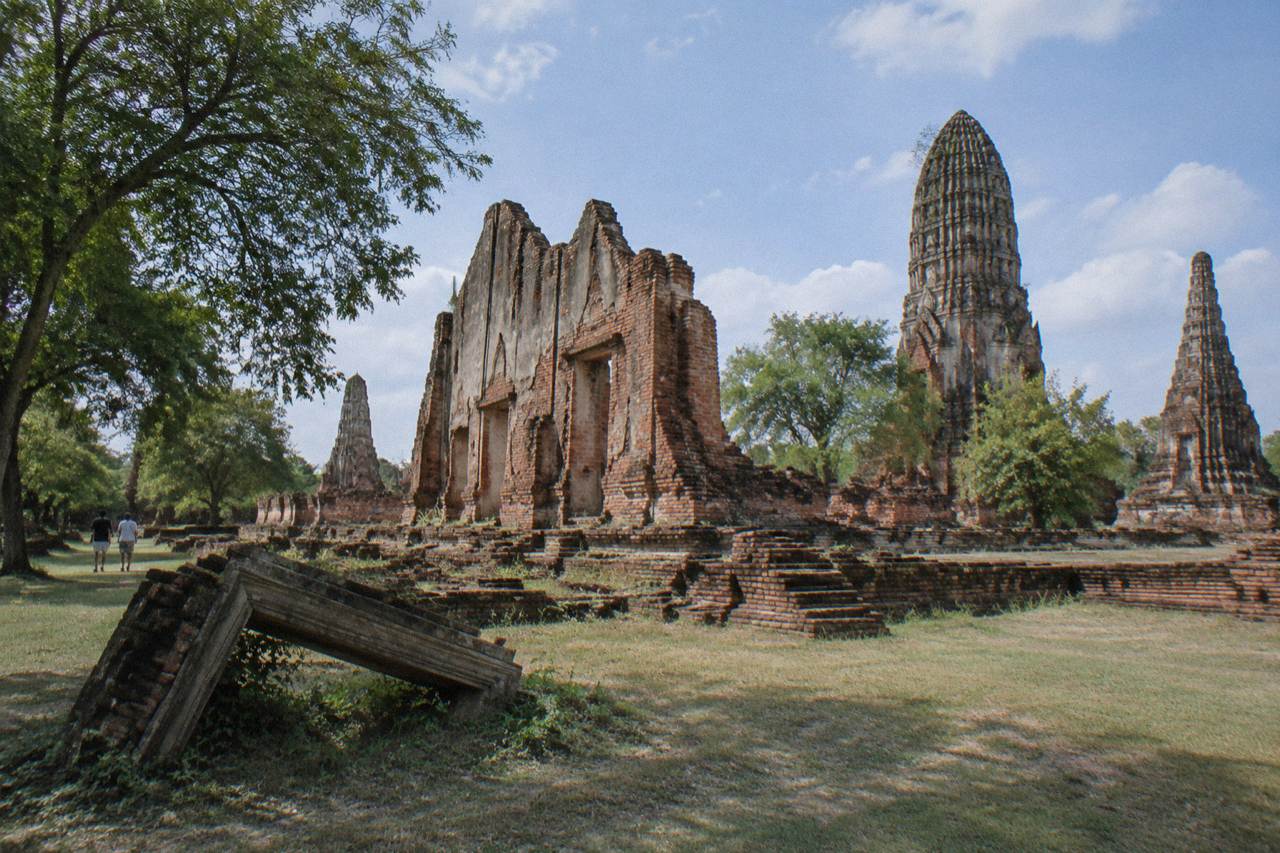
Ayutthaya shows a dense city of brick and laterite ruins, temples packed onto a river island, with the famous Buddha head wrapped in tree roots at Wat Mahathat and the riverside prangs of Wat Chaiwatthanaram glowing at sunset. Sukhothai shows a more spread-out, park-like landscape of ponds, lawns and smaller monuments, which most travellers describe as quieter and more serene.
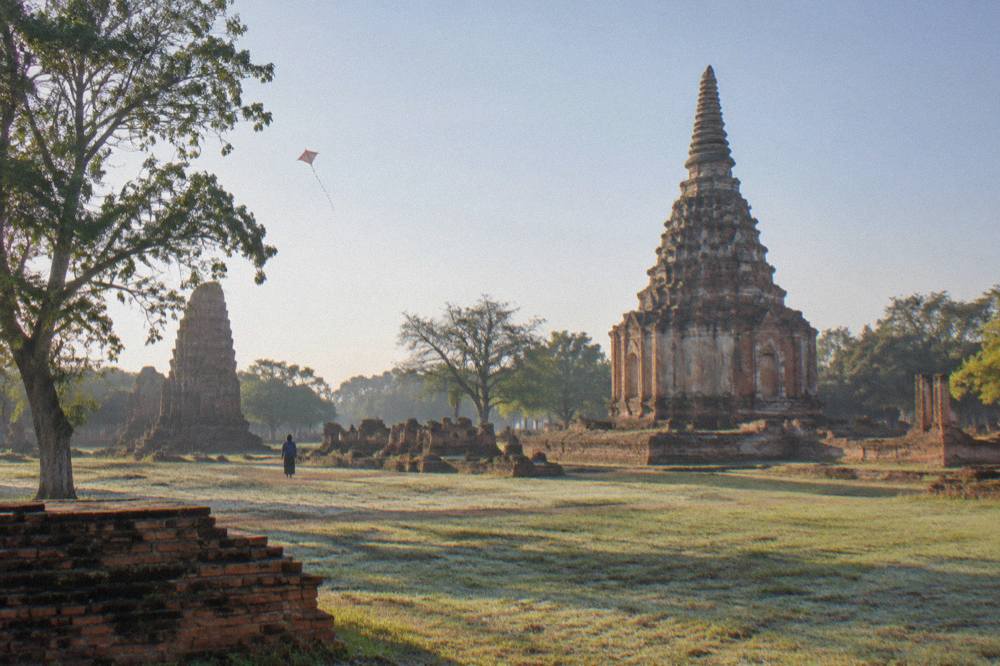
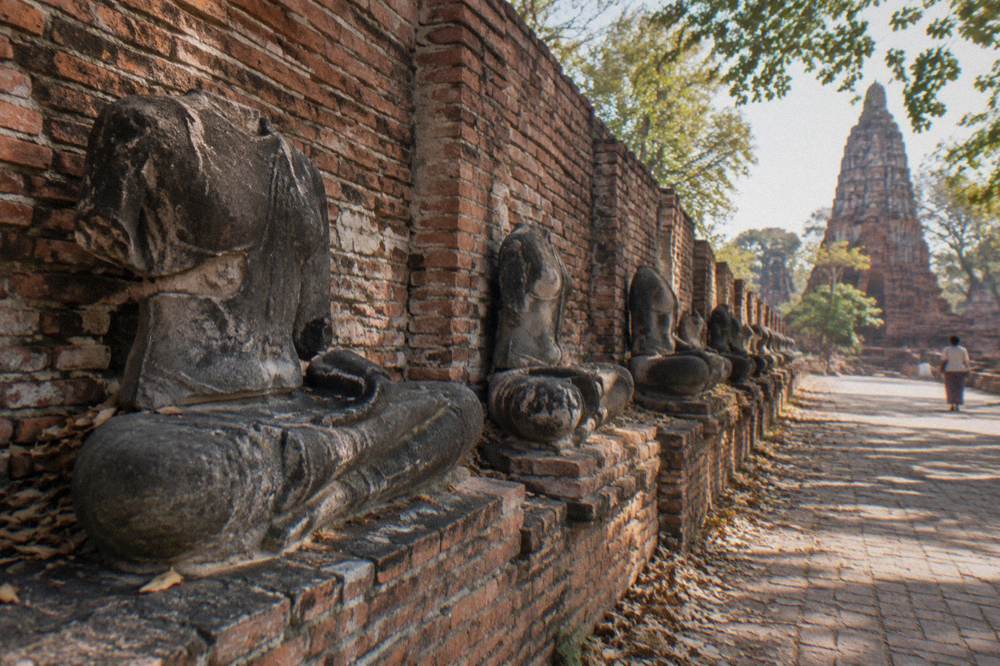
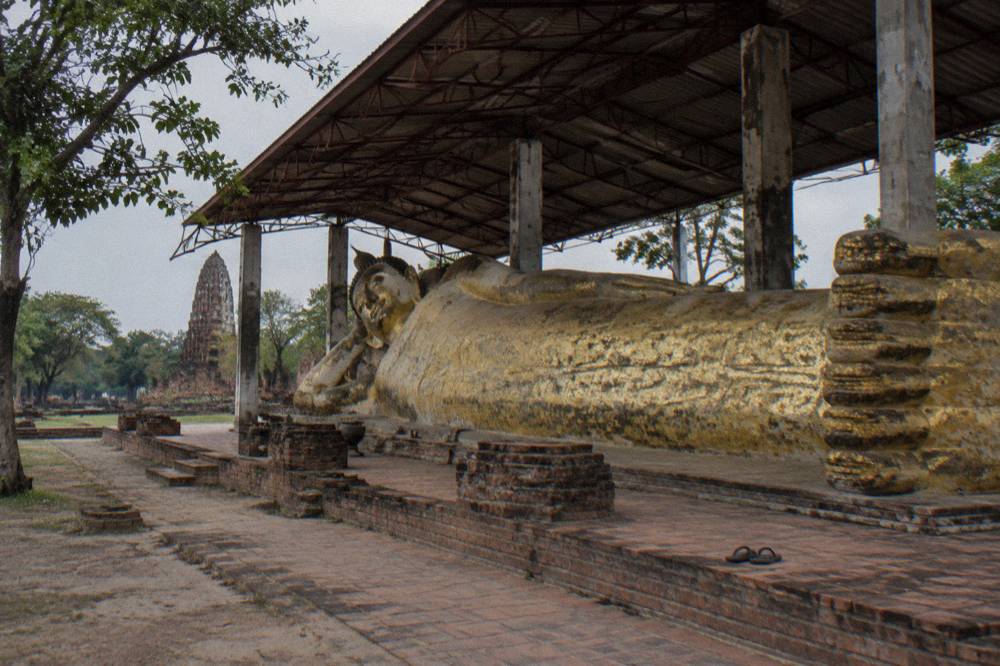
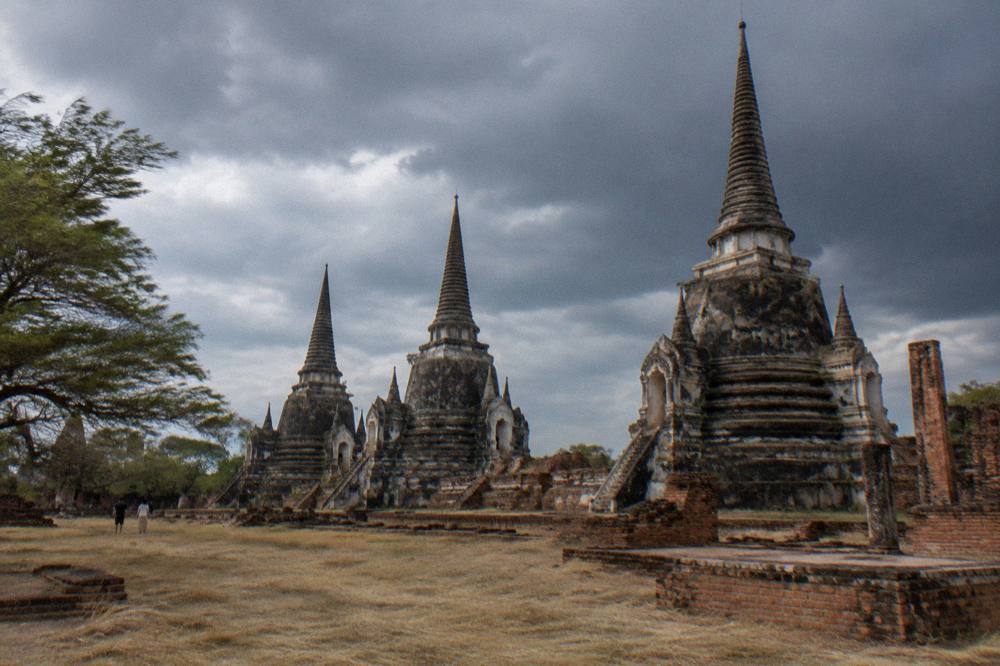
The visual character differs more than the guidebooks usually admit. Ayutthaya was a working capital of hundreds of temples before 1767, and the ruins today cluster thickly: you can walk or cycle between Wat Phra Sri Sanphet's three landmark chedis, the Reclining Buddha at Wat Lokayasutharam and the tree-root Buddha head within an hour of easy riding. The park grounds are free to enter, with fees only at ticketed monuments, and the official foreigner rate is 80 baht per site or 300 baht for the seven-site ticket, sold in cash at the gates with no advance online booking through official channels. The Fine Arts Department's official park map page lists the covered sites and current rates.
Sukhothai's ruins, by general traveller account, sit in a wider, greener setting: monuments separated by stretches of water and trees, with a more spread-out central zone. The mood travellers report is closer to a landscaped historical park than a dense ruin field. That spread also means you cover more ground between highlights, usually by bicycle or rented vehicle, and a full circuit of the main zone takes most of a day rather than a few hours.
| Ayutthaya fact | Figure |
|---|---|
| Founded | 1351 |
| Sacked by the Burmese army | 1767 |
| UNESCO inscription | 1991, criterion iii |
| Distance from Bangkok | About 76 km |
| Park hours | Daily 8am to 6pm |
| Foreigner ticket | 80 baht per site, 300 baht for the 7-site combo |
| Park grounds | Free to enter |
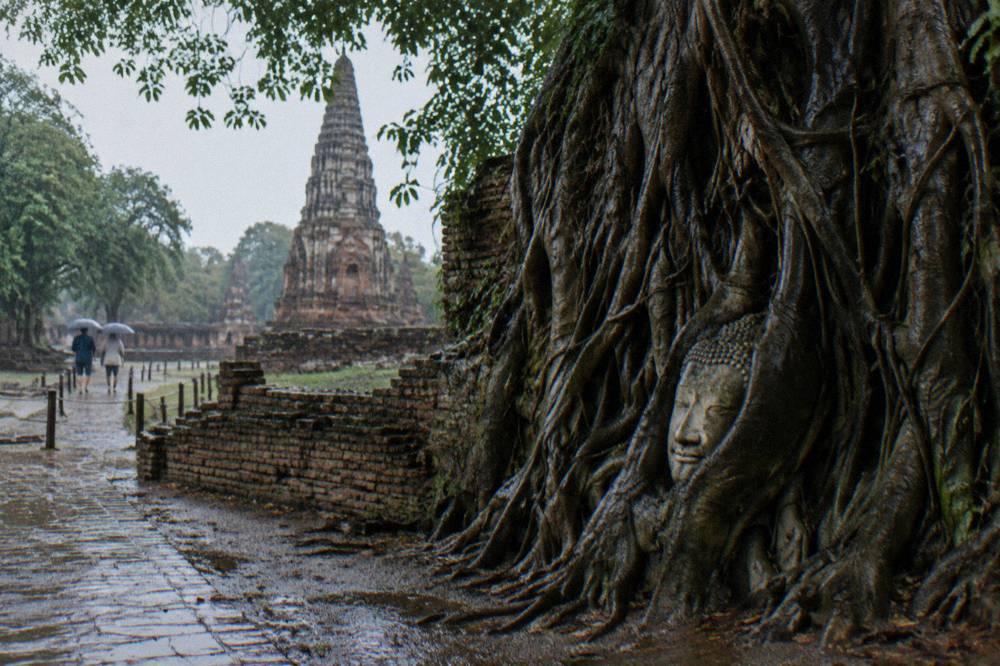
The famous image of Ayutthaya, the Buddha head at Wat Mahathat, carries its own etiquette: visitors crouch or kneel so their head sits lower than the Buddha's, and nobody touches the roots. The site was inscribed by UNESCO in 1991 under criterion iii, and the story of the head itself, how it ended up inside the banyan, is covered in the Wat Mahathat Buddha head guide.
For the sunset end of the day, Wat Chaiwatthanaram on the west bank is the riverside spot, and despite the September and October 2026 river rises the site has stayed open, protected by a 165 metre flood barrier 1.9 metres high. The Wat Chaiwatthanaram at sunset guide explains how to time it.
How Do The Costs Compare?
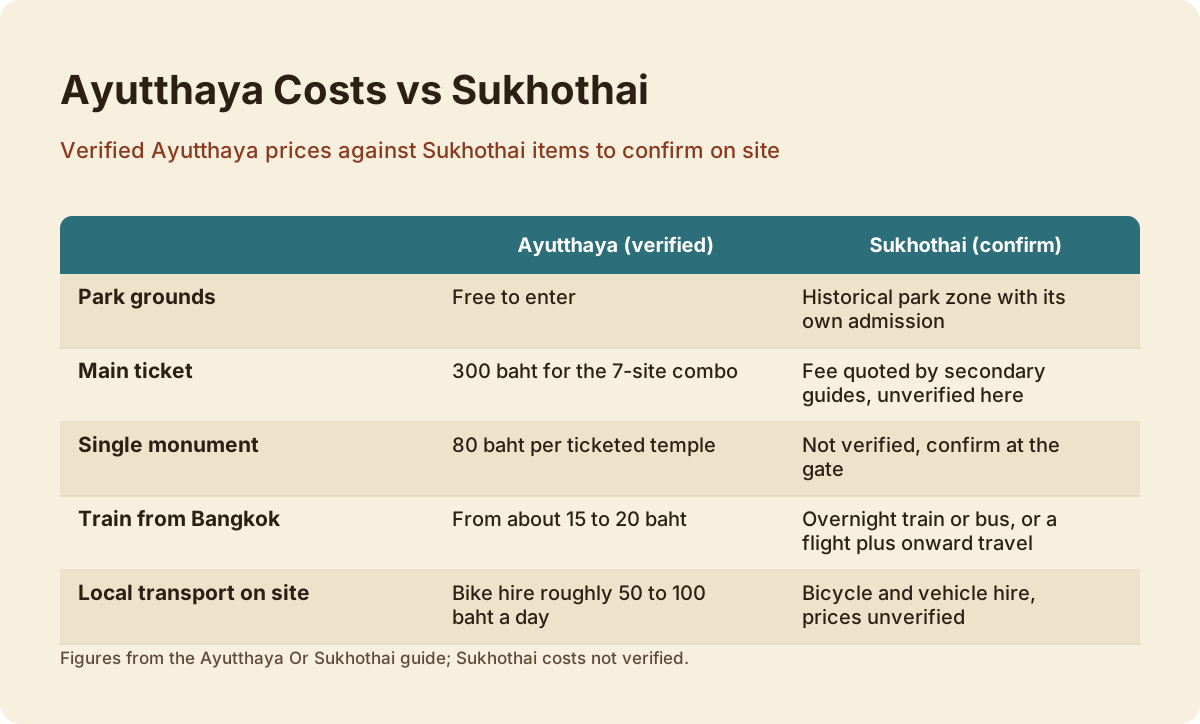
A day at Ayutthaya is cheap and fully priced in official figures: park grounds free, 80 baht per ticketed temple or 300 baht for the seven-site ticket, ordinary trains from about fifteen to twenty baht and bike hire roughly 50 to 100 baht a day. Sukhothai's costs are not verified here, so treat any fee you see quoted for it as something to confirm on site.
The honest position on Sukhothai's numbers is that we do not have verified figures, and we would rather say so than print a plausible-sounding fee. What can be said generally: Sukhothai charges its own monument admission, quoted by secondary guides in the same tens-of-baht range as other Thai historical parks, and its spread-out layout usually adds bicycle or vehicle hire to the day. The bigger cost difference is not the ticket, it is the journey: a day at Ayutthaya costs a train fare, while Sukhothai implies an overnight train, a hotel night or a flight connection.
| Cost item | Ayutthaya (verified) | Sukhothai (general, confirm on site) |
|---|---|---|
| Park grounds | Free to enter | Historical park zone with its own admission |
| Main ticket | 300 baht for the 7-site combo, foreigners | Fee quoted by secondary guides in a similar low range, unverified here |
| Single monument | 80 baht per ticketed temple | Not verified, confirm at the gate |
| Getting there from Bangkok | Train from about 15 to 20 baht; BNEX promo capped at fifty baht | Overnight train or bus, or a northern flight plus onward travel |
| Local transport on site | Bike hire roughly 50 to 100 baht a day | Bicycle and vehicle hire commonly used, prices unverified |
Ayutthaya's ticketed sites are Wat Phra Si Sanphet, Wat Phra Ram, Wat Mahathat, Wat Ratchaburana, Wat Chaiwatthanaram, Wat Maheyong and Wat Kudi Dao. Smaller active temples charge less: Wat Yai Chai Mongkhon asks about 20 baht, and Wat Lokayasutharam, home of the Reclining Buddha, is free. The Chao Sam Phraya National Museum charges foreigners 150 baht if you want artifacts and context between temple stops.
Tours change the cost structure but remove the logistics. The temples tour from Bangkok with lunch, rated 4.7 from 867 reviews, includes lunch and covers the Reclining Buddha, Wat Phra Sri Sanphet, Wat Mahathat and Wat Chaiwatthanaram in seven and a half hours. Prices live on the listings, so compare them there rather than trusting any cached figure.
How Much Time Does Each Park Need?
Ayutthaya works as a half-day, a full day or a relaxed overnight: the headline temples sit close together, and three to five hours covers the core circuit. Sukhothai realistically needs a full day on site plus the travel days around it, because the monuments spread across a wider zone and the journey from Bangkok consumes a night each way.
This is where the comparison becomes a scheduling decision. Ayutthaya's compactness is its quiet superpower. The island is flat, the distances between major ruins are short, and travellers who arrive on an early train can see Wat Mahathat, Wat Phra Sri Sanphet and Wat Chaiwatthanaram and still be back in Bangkok for dinner. The park keeps daily hours of 8am to 6pm, and the question of how long you need has a dedicated longread answer on this site.
Sukhothai does not compress. Even travellers who love it report that the central zone alone fills a day, and the surrounding zones add more. Add the overnight positioning and Sukhothai is a two-day minimum commitment from Bangkok, realistically three if you want to arrive rested.
Tour durations at Ayutthaya reflect that compressibility. The full-day small-group tour runs eleven and a half hours because it includes hotel pickup, Bang Pa-In Palace and a leisurely pace. The boat-ride experience run by TRIPZA sightseeing, rated 4.9 from 861 reviews, fits the whole visit into eight hours with a river boat leg. And the floating market day trip run by Hana Go Pro, rated 4.7 from 6,382 reviews, pairs the temples with the Ayothaya market in the same eight-hour frame. Sukhothai has no equivalent same-day product from Bangkok at all.
What Kind Of Traveller Prefers Sukhothai?
Sukhothai suits travellers already committed to northern Thailand: those on a Chiang Mai loop, photographers who want lawns and water rather than dense brick, and visitors who value quiet over convenience. If your trip is Bangkok-centric and time is short, none of those preferences outweigh the overnight journey Sukhothai demands.
The case for Sukhothai is real and worth stating fairly. Travellers who have seen both often describe Sukhothai as the more atmospheric of the two: fewer crowds at dawn, monuments reflected in lotus ponds, a sense of space Ayutthaya's packed island cannot offer. If your itinerary already includes the north, adding Sukhothai costs a modest detour and delivers one of the country's most photogenic historical settings.
The case against, for a Bangkok-based traveller, is arithmetic. Two nights of travel and positioning to see one park, versus a train fare and a single day. For most first-time visitors with a week in Thailand, that trade is not close. The is Ayutthaya worth visiting piece on this site covers the value question from the Bangkok side.
There is also a season angle. Ayutthaya's cool dry window runs November to February with highs around 31C, while March to May pushes 34 to 36C and June to October brings afternoon rain, with September the wettest month and October carrying flood risk along the Chao Phraya. Sukhothai shares the same broad seasonal pattern, so weather rarely decides between them, but it should decide when you go to either.
Can You Combine Both In One Trip?
Yes, but only as a northbound route, not a double day trip. The realistic pattern is Ayutthaya as a day trip from Bangkok at the start or end of your stay, then Sukhothai as a stop on the overnight journey toward Chiang Mai. Trying to see both from Bangkok inside two days is the one genuinely bad plan in this comparison.
The workable version looks like this. Spend a day at Ayutthaya while you are Bangkok-based, either independently by train or on a tour with hotel pickup. Then, when you head north, break the Bangkok to Chiang Mai journey at Sukhothai: the northern rail and bus routes pass through the region, and travellers commonly overnight near the park before continuing. That sequence gives you both capitals without backtracking.
The unworkable version is the day-trip squeeze: an overnight bus to Sukhothai, a rushed half day, and a long return. You would arrive tired, see the central zone at midday heat and spend more of your trip on transport than at either park. If two ancient capitals both matter to you, the honest advice is to give Ayutthaya its day from Bangkok and fold Sukhothai into a northern leg you were already doing.
For the Ayutthaya half of that plan, the best day trip guide ranks the options, and the one-day itinerary sequences the temples if you go independently.
Who Should Pick Which Park?
Pick Ayutthaya if you are based in Bangkok with one to two free days, want temples, history and a river sunset inside a single outing, or want a guided product with hotel pickup and free cancellation. Pick Sukhothai only if your route already runs north and you have a spare overnight for a quieter, more spread-out park.
The decision table below is the short version of everything above. It assumes the most common scenario, a traveller staying in Bangkok with limited time, which is the situation where the answer is least ambiguous.
| Your situation | The better pick | Why |
|---|---|---|
| One free day in Bangkok | Ayutthaya | About 76 km, train in roughly 1h15, tours with hotel pickup exist |
| A week split between Bangkok and Chiang Mai | Both, on the northbound leg | Ayutthaya as a day trip, Sukhothai as an overnight stop |
| Photography at dawn with few people around | Sukhothai | Wider, quieter park, though plan the overnight positioning |
| First trip to Thailand, temples are a checkbox | Ayutthaya | Headline sights cluster together, easy logistics, deep tour bench |
| Travelling with children or older parents | Ayutthaya | Short journey, flexible half-day tours, flat compact park |
| You dislike crowds at ruins | Sukhothai, with a caveat | Quieter overall, though Ayutthaya at opening time is also calm |
Two honest caveats. First, Ayutthaya is not a secret: the headline temples draw coach groups from mid-morning, and the best time of day piece shows how to dodge them. Second, Sukhothai's advantages depend on weather and light; a rainy-season visit can leave you with grey skies over the ponds, so the November to February window matters there too.
For most readers of Ayutthaya Historical Park Tours, the comparison resolves itself the moment they check a map. The ruins that fit your trip are the ones you can actually reach, and from Bangkok that means the old capital on the river, and the small-group full-day tour is the easy way in if you want the whole thing handled for you.
Whichever way you lean, the three listings below cover the main ways to see Ayutthaya from Bangkok: a small-group full day, a private car with a driver-guide, and a full-day bike tour of the island.
Common Questions About Ayutthaya Or Sukhothai
Is Ayutthaya or Sukhothai better for a day trip from Bangkok?
Ayutthaya, and it is not close. It lies about 76 km away with a train run of roughly one hour fifteen minutes, while Sukhothai requires overnight travel. No same-day tour product from Bangkok to Sukhothai exists on any roster we have seen.
Can you visit Sukhothai as a day trip from Bangkok?
Not realistically. The distance means an overnight train or bus each way, so travellers who do it properly spend a night near the park. Attempting it as a return day trip leaves a few rushed hours on site.
Which park has the more impressive ruins?
They are different rather than ranked. Ayutthaya offers dense, monumental brick and laterite ruins, including the tree-root Buddha head and the riverside prangs of Wat Chaiwatthanaram. Sukhothai offers a wider, greener park of ponds and lawns that travellers describe as more serene.
How much does it cost to visit Ayutthaya?
Park grounds are free. Foreigners pay 80 baht per ticketed temple or 300 baht for the official seven-site ticket, cash only at the gates. The ordinary train from Bangkok costs about fifteen to twenty baht, and bike hire runs roughly 50 to 100 baht a day.
Is it worth seeing both Ayutthaya and Sukhothai?
Yes, if your route allows it. The sensible pattern is Ayutthaya as a day trip from Bangkok, then Sukhothai as an overnight stop on the journey north toward Chiang Mai. Trying to combine both from Bangkok inside two days is the one plan to avoid.
Which park is better in rainy season?
Neither escapes the June to October monsoon, with September the wettest month and October carrying flood risk. Ayutthaya's riverside sites can see temporary access restrictions when the Chao Phraya rises, as happened in the autumn of 2026, though the headline temples stayed open behind flood barriers.