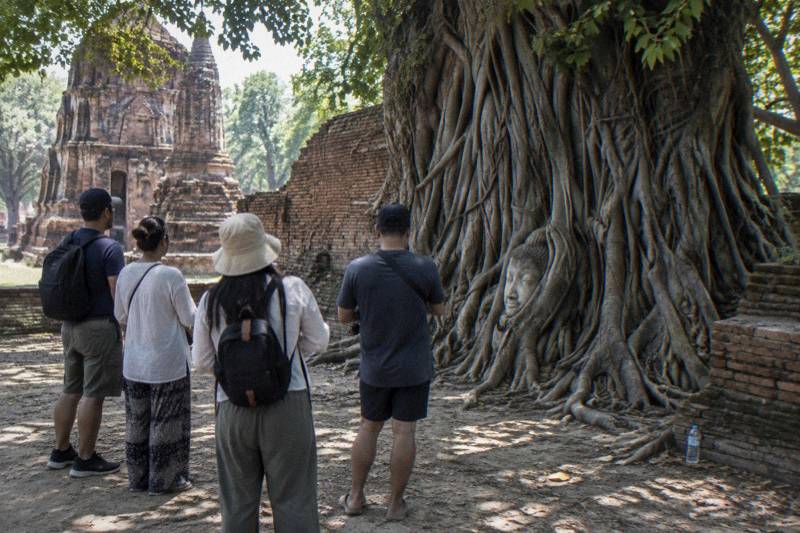
Wat Mahathat And The Buddha Head In The Tree
The Buddha head wrapped in tree roots at Wat Mahathat is the single most photographed sight in Ayutthaya, and almost every organised day trip from Bangkok builds its itinerary around it. This guide covers what the site actually is, how long to allow, the 80 baht foreigner fee, the crouch-or-kneel photo etiquette the site asks of visitors, and which listed tours name Wat Mahathat on their itineraries.
Short answer
Wat Mahathat is a ruined royal temple in Ayutthaya Historical Park, within a city established in 1351 and sacked in 1767. Foreign visitors pay 80 baht entry, or 300 baht for the official seven-site combo ticket. Allow about half an hour. Photograph the famous Buddha head crouching or kneeling, head lower than the Buddha head, never touching the roots.
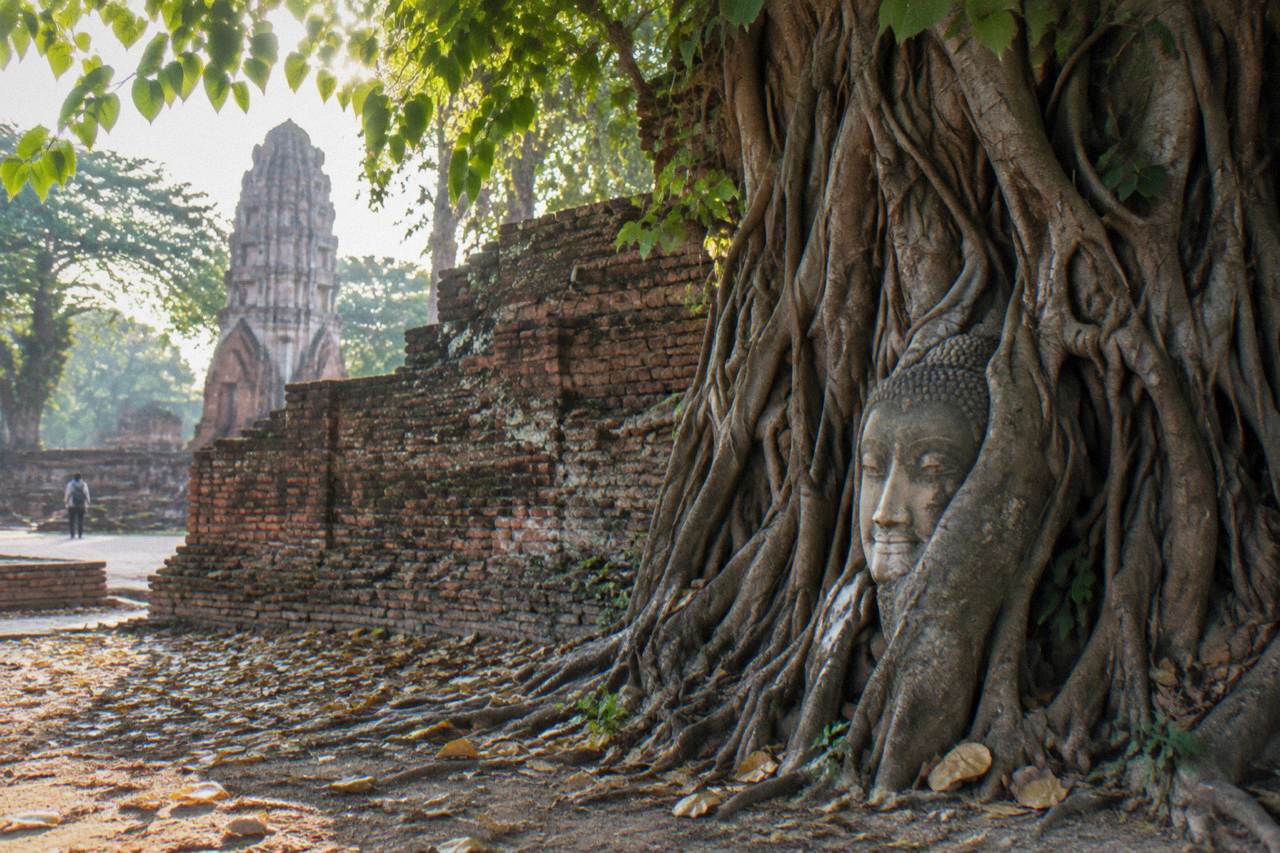
The Buddha head at Wat Mahathat does not sit on a pedestal or behind glass. It rests in the forked roots of a bodhi tree, the stone face half swallowed by wood, and it has become the image most travellers take home from Ayutthaya. Almost every itinerary to the old capital, whether a guided day trip from Bangkok or a self-planned train journey, puts this ruin near the top of the list, and for good reason: it is the most complete visual shorthand for what happened to this city, a royal temple complex abandoned after the sacking of 1767 and slowly reclaimed by the forest that grew back over it. If you want the fuller picture of what else this ruined capital offers, the guide to what makes Ayutthaya famous covers the temples and riverside prangs beyond Wat Mahathat.
This guide walks through the site itself, the practical logistics of a visit, the etiquette that the Buddha head specifically asks of photographers, and the tours on this site's roster that name Wat Mahathat in their listings. The park is managed by the Fine Arts Department, and the official virtual historical park map page is the source for the fees and hours quoted throughout. For a wider view of the temple circuit, the temples the Ayutthaya tours visit guide covers the full roster of ruins.
What Is The Buddha Head In The Tree At Wat Mahathat?
Wat Mahathat was one of Ayutthaya's most important royal temples, built in the heart of the city and abandoned after the Burmese army sacked the capital in 1767; the Buddha head now embedded in tree roots is a stone carving that the growing trunk gradually enclosed, and nobody knows for certain how it ended up there. The city itself was founded in 1351, and Wat Mahathat served as the religious centre of the royal quarter, housing relics associated with the Buddha and acting as the seat of the monastic community that officiated royal ceremonies. When the city fell in 1767 the temple was burned and looted like the rest of the island, then left to the jungle for more than a century before restoration began. If the mystery of how that head ended up in the roots has you curious, the full story behind Ayutthaya's tree-wrapped Buddha head covers what the historical record actually shows and how to see it respectfully.
The head itself is carved from laterite or sandstone, accounts vary, and it sits at ground level where two roots have grown around it in a near-perfect embrace. The most common explanation is simply gravity and time: a fallen head left on the ground beside a young tree, and a trunk that thickened around it over two centuries. That is the version the site's own materials lean toward, and it is the version that requires the least invention. The verified history of the park, from the 1351 founding to the 1767 sacking and the eventual UNESCO inscription in 1991, is documented on the Ayutthaya Historical Park reference page, and the deeper mystery of the missing body of the statue is covered in the site's own article on why the Buddha head is missing in Ayutthaya.
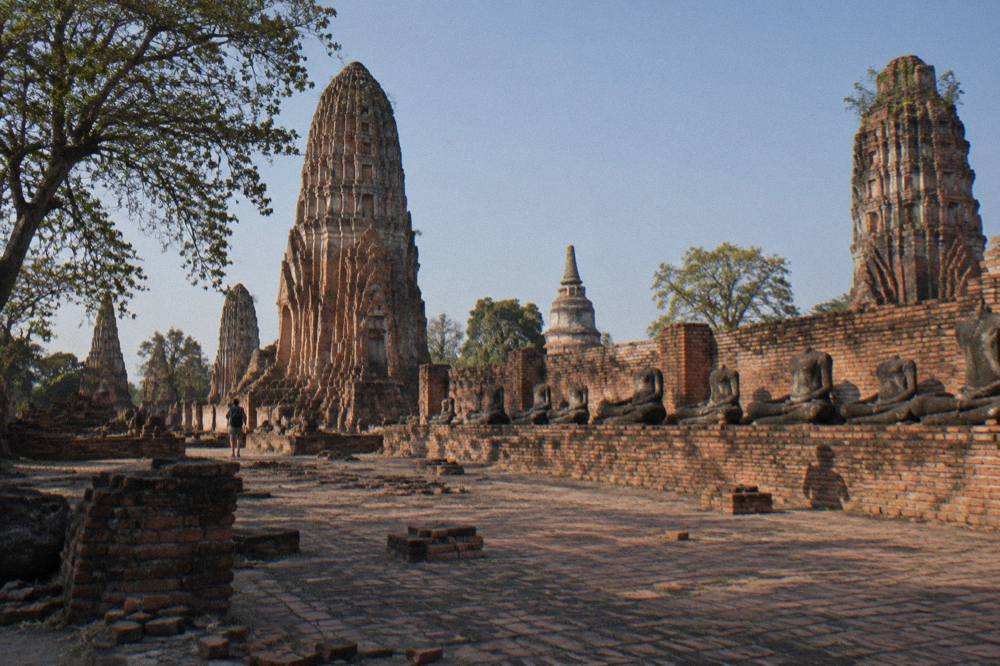
What surprises most first-time visitors is the scale of the surrounding ruin. The head is the famous shot, but Wat Mahathat is a large compound of broken prangs, rows of headless Buddha figures, and the reconstructed base of the main chedi. The rows of Buddhas in the ordination hall, all missing their heads, are nearly as striking as the tree itself. Take the time to walk the full perimeter, because the composition of broken columns against sky is what earned this park its World Heritage status under criterion three, recognising the site as an exceptional witness to Siamese civilisation. You can spend twenty minutes at the head and miss the rest, which would be a shame.
How Much Time Should You Allow At Wat Mahathat?
Most visitors need about half an hour at Wat Mahathat: roughly ten minutes at the Buddha head itself, allowing for a queue at peak times, and the rest of the stop walking the wider compound of prangs, chedi bases and the rows of headless Buddhas. Guided tours typically budget similar time, with the small-group full-day tour from Bangkok allocating a stop here among four or five named temples across an 11 hour 30 minute day. If you are visiting independently and arrive early before the crowds, you can see the essentials in twenty minutes; if you arrive mid-morning with three coach parties, the queue at the head alone can eat half an hour.
The table below pulls together the practical logistics for an independent visit. Park hours are official, 8am to 6pm daily; the fee structure comes from the Fine Arts Department's own page for the park.
| Item | Detail |
|---|---|
| Location | Central zone of Ayutthaya Historical Park island, a short walk from Wat Phra Sri Sanphet |
| Park hours | Daily, 8:00am to 6:00pm |
| Foreigner entry fee | 80 baht per site |
| Seven-site combo ticket | 300 baht, covers Wat Mahathat plus six other ticketed monuments |
| Payment | Cash at the gate; no advance online booking through official channels |
| Suggested visit length | About half an hour |
| Best light for photos | Early morning before 9am, or late afternoon after 4pm |
| Peak crowding | Roughly 10am to 2pm, when day-trip coaches from Bangkok arrive |
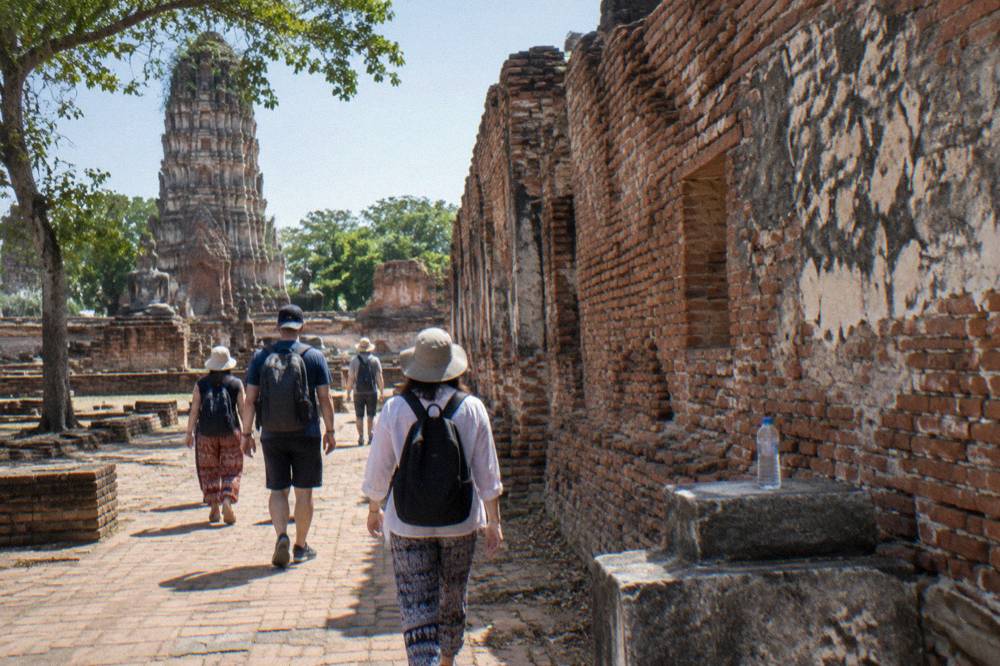
One planning note that matters more than people expect: Wat Mahathat sits in the middle of the island, and the walk between it and the next major ruins is short and flat. The whole central cluster, Wat Phra Sri Sanphet, Wat Phra Ram and Wat Ratchaburana, can be covered on foot in a loop of under two hours. If you are deciding between doing that independently or joining an organised trip, the Ayutthaya guided tour or on your own comparison walks through the trade-offs in detail.
If you would rather have the logistics handled end to end, these are three listings from the site's roster that all name Wat Mahathat directly.
Which Tours And Listings Include Wat Mahathat?
Wat Mahathat appears on more of this site's listings than any other single temple: it is named on the small-group temples tour with lunch, the full-day UNESCO tour, the boat-ride experience, the railway and floating markets combo, the sunset tours, and the private guided day tour of four ancient temples, among others. In total, more than a dozen of the 21 listings on the roster name it explicitly. That is worth knowing for two reasons. First, if Wat Mahathat is your priority, you genuinely cannot pick a "wrong" day trip from Bangkok; nearly all of them call here. Second, the difference between listings is not whether they include this temple but what surrounds it: the group size, the pace, the transport, and which other ruins fill the day.
The table below lists a representative selection of listings that name Wat Mahathat, with the details that are printed on each listing. Ratings and review counts are stated exactly as verified on the roster. The full index of guides sits on Ayutthaya Historical Park Tours.
| Listing | Operator | Rating and reviews | Duration | Group size |
|---|---|---|---|---|
| Ayutthaya Temples Tour from Bangkok with Lunch | Bigcountry Experience | 4.7 from 867 reviews | 7 hours 30 minutes | Max 25 travellers |
| UNESCO's Ayutthaya Historical Park: Full-Day Tour | TripGuru Thailand | 4.7 from 1,728 reviews | 11 hours 30 minutes | Max 9 travellers |
| Bangkok: Ayutthaya Experience with Boat Ride and Tickets | TRIPZA sightseeing | 4.9 from 861 reviews | 8 hours | Group, private option |
| Ayutthaya Sunset Tour: UNESCO Temples and Sunset Cruise | Sunleisure World | 4.4 from 368 reviews | 8 hours | Max 22, private option |
| Ayutthaya Private Guided Day Tour, 4 Ancient Temples | Golden Dragon International | 4.5 from 68 reviews | Not stated on the listing | Private |
| Colors of Ayutthaya Full-Day Bike Tour | ThailandBiking, Ayutthaya branch | 4.8 from 66 reviews | 6 hours | Max 15 travellers |
The small-group full-day tour run by TripGuru Thailand is the tightest fit if the Buddha head is the centrepiece of your day: with a maximum of nine travellers and a full 11 hours 30 minutes, it gives the temple circuit more breathing room than any other listing, and hotel pickup from central Bangkok is stated on the listing. It also visits Wat Phra Sri Sanphet, Wat Chaiwatthanaram and Bang Pa-In Palace in the same day, which is close to the full historical-park checklist.
The temples tour with lunch, run by Bigcountry Experience, is the mid-weight option: 7 hours 30 minutes, up to 25 travellers, lunch included per the listing, and hotel pickup stated. It names Wat Lokayasutharam, Wat Phra Sri Sanphet, Wat Mahathat and Wat Chaiwatthanaram, which is the classic four-temple circuit in a single efficient loop. If you want the overview without committing a full day, this is the listing most people land on, and you can check the temples tour with lunch on its tour page for the full itinerary.
The boat-ride experience run by TRIPZA sightseeing adds a river element: an air-conditioned vehicle out, a river boat on the return leg, hotel pickup in Bangkok included, and a 4.9 rating from 861 reviews. It names Wat Mahathat, Wat Yai Chai Mongkhon and Wat Chaiwatthanaram, and a private group version is available. For travellers who want water in the mix without paying the private tier, it is the natural pick.
Between them, these three listings cover the main formats a day visitor can choose: an efficient group loop with lunch, a small-group deep dive, and a hybrid with a river leg. All three name Wat Mahathat, all include hotel pickup from Bangkok, and all carry free cancellation, so the decision comes down to pace and budget rather than itinerary.
How Do You Take A Respectful Photo Of The Buddha Head?
The site asks visitors to crouch or kneel so that their head sits lower than the Buddha head when photographing or being photographed beside it, and never to touch the roots or climb on the tree; standing above the head, pointing feet toward it, or leaning on the roots for a pose are all considered disrespectful. This is not an arbitrary rule invented for tourists. The head is treated as a religious object, not a prop, and in Thai Buddhist practice a person should not position themselves above a Buddha image. Signs at the site and the staff who supervise the spot will ask you to lower yourself, and most visitors comply without complaint once they understand the reason.
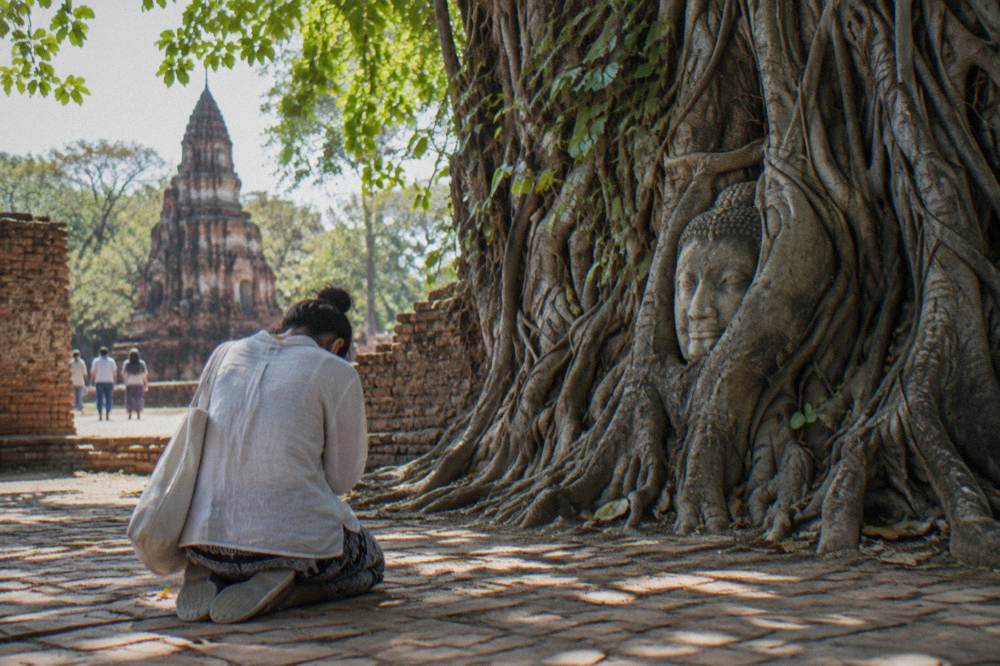
The etiquette is short and easy to follow. The table below is the do-and-do-not version.
| Do | Do not |
|---|---|
| Crouch or kneel so your head is lower than the Buddha head | Stand over the head or pose above it |
| Keep a small gap between you and the roots | Touch, hold or lean on the roots |
| Let the site staff guide you to the accepted photo spot | Step over the low barrier for a closer angle |
| Wear shoulders and knees covered, as at any Thai temple | Arrive in swimwear, vest tops or short shorts |
| Take your shot efficiently and move on when a queue forms | Monopolise the spot during peak hours |
Dress matters here as everywhere in the park: shoulders and knees covered is the standard expectation at Thai temple sites, and the what to wear to Ayutthaya temples guide covers fabric choices and the heat trade-off in detail. On the practical side, the head sits low to the ground in shade for much of the day, so morning light angled through the tree is the most forgiving for photographs. If you are building a photo-focused day around light rather than coach schedules, the best time of day to visit Ayutthaya article ranks the whole park by hour.
What Does It Cost To Visit Wat Mahathat?
Foreign visitors pay 80 baht to enter Wat Mahathat, or 300 baht for the official seven-site combo ticket that also covers Wat Phra Si Sanphet, Wat Phra Ram, Wat Ratchaburana, Wat Chaiwatthanaram, Wat Maheyong and Wat Kudi Dao; tickets are sold in cash at the gate and there is no advance online booking through official channels. The park grounds themselves are free to walk and cycle through; fees apply only at the ticketed monuments. The combo ticket is bought at the first included site you visit, and its validity period is not settled in the sources this site relies on, so check at the booth when you buy.
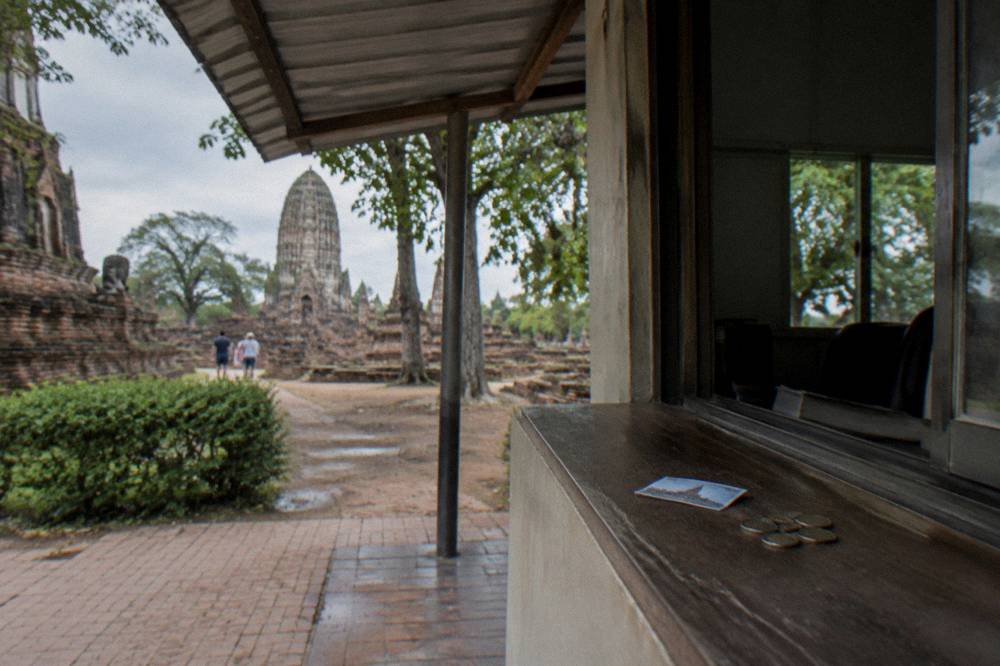
The arithmetic is simple: if your day includes three or more of the seven ticketed sites, the 300 baht combo costs less than buying singles at 80 baht each. A typical four-temple day trip, Wat Mahathat, Wat Phra Sri Sanphet, Wat Chaiwatthanaram and one more, pays for the combo twice over. Two quick notes on the smaller sites: Wat Lokayasutharam, the giant reclining Buddha, is free, and Wat Yai Chai Mongkhon charges about 20 baht per secondary 2026 guides. Chao Sam Phraya National Museum charges foreigners 150 baht if ruins alone are not enough for one day.
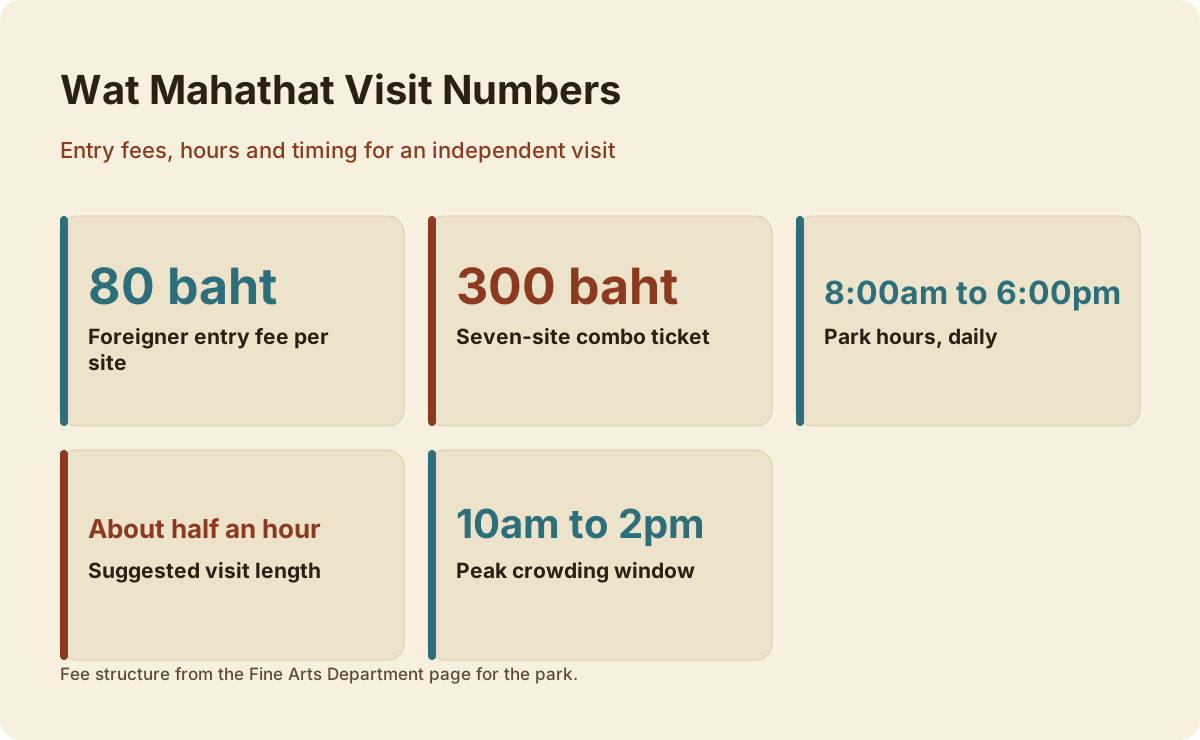
One point worth repeating because so many guides get it wrong: temple entry is not something you can pre-book online, and no official channel sells advance tickets. Any tour listing that includes entry will say so in its inclusions; where the roster is silent, assume you pay cash at the gate yourself and carry small notes. The fees above are the official Fine Arts Department figures, and they supersede the lower numbers still circulating on some older guide pages.
When Is The Best Time Of Day To See The Buddha Head?
Early morning, between 8am and 9am, is the best window at Wat Mahathat: the park opens at 8am, the light is soft and angled through the tree, and the coach crowds from Bangkok have not yet arrived, while mid-morning through early afternoon brings queues at the head itself. The second-best window is late afternoon after 4pm, when most day trips have moved on to their sunset stops and the light turns warm. The trade-off with the late window is simple: the park closes at 6pm, so you are working with a hard stop.
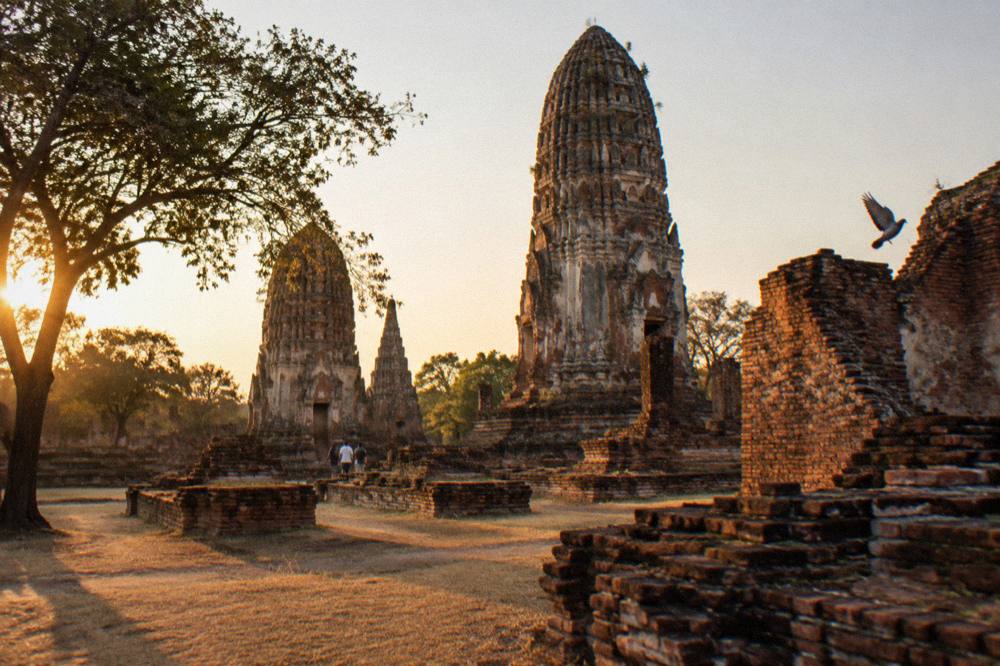
The rhythm of the day is driven almost entirely by Bangkok departures. Most guided day trips leave the capital between 7am and 8am and reach Ayutthaya around 9:30am to 10:30am, which is why the central temples fill up in that window and why the what time Ayutthaya tours leave Bangkok article is worth a read before you book anything. Independent travellers have an edge here: the first trains from Krung Thep Aphiwat arrive before the coaches, and an 8am start at Wat Mahathat means photographing the head with two people in the frame instead of twenty. The new BNEX air-conditioned commuter service covers the run in about 1 hour 15 minutes, with promotional fares capped at fifty baht through 31 October 2026, and ordinary third-class trains run from about 15 to 20 baht.
There is a seasonal dimension too. The cool dry season from November to February, with highs around 31C, is the comfortable window; the hot season from March to May pushes 34 to 36C and makes midday walking genuinely hard work; the rainy season from June to October brings afternoon downpours, with September the wettest month and October carrying flood risk. In late September and early October 2026 the Chao Phraya rose and the Fine Arts Department installed a 165 metre, 1.9 metre high flood barrier along the riverfront at Wat Chaiwatthanaram, but Wat Mahathat and the other central temples reported no closures. The best time to visit Ayutthaya guide covers the full seasonal picture.
How Does Wat Mahathat Fit Into A Day Trip From Bangkok?
Wat Mahathat sits at the centre of the historical park island, so it anchors almost any route: pair it with Wat Phra Sri Sanphet next door, add Wat Chaiwatthanaram on the west bank for the sunset, and you have the backbone of a day that every tour format, coach, bike or private car, covers in some order. The distance from Bangkok is about 76 km by road, which translates to roughly 1 to 1.5 hours by minivan, 1.5 to 2 hours by bus, or about 1 hour 15 minutes on the newer train services. A taxi or ride app runs roughly 900 to 1,500 baht one way per 2026 guides, which is why most independent travellers take the train and most everyone else takes a tour.
The format you choose changes the day more than the itinerary does. A coach-based group tour moves temple to temple on a fixed clock, with the Buddha head typically the first or second stop. A bike tour covers the same ground at handlebar pace: the Colors of Ayutthaya full-day bike tour, rated 4.8 from 66 reviews, spends six hours among the ruins with a maximum of 15 travellers and lunch included, and it names Wat Mahathat alongside Wat Lokayasutharam, Wat Phra Sri Sanphet, Wat Chaiwatthanaram and Wihan Phra Mongkhon Bophit. A shorter option, the Ayutthaya City and Historical Park bike tour run by Recreational Bangkok Biking, covers the highlights in 3 to 3.5 hours with a private group option available, rated 4.8 from 188 reviews.
Cycling suits this park unusually well because the terrain is dead flat and the distances between ruins are short. The trade-offs are heat and traffic etiquette, both covered honestly in the is an Ayutthaya bike tour hard in the heat article, and the full Ayutthaya bike tour guide compares the three bike listings on the roster. Whichever format you choose, the practical advice converges on the same point: get to Wat Mahathat early or late, crouch for the photo, carry cash for the gate, and let the rest of the day arrange itself around it.
If you are still choosing between the main formats, these are the three listings this guide has focused on, side by side.
Common Questions About The Wat Mahathat Buddha Head
How much does it cost to visit Wat Mahathat?
Foreign visitors pay 80 baht per site, or 300 baht for the official seven-site combo ticket covering Wat Mahathat, Wat Phra Sri Sanphet, Wat Phra Ram, Wat Ratchaburana, Wat Chaiwatthanaram, Wat Maheyong and Wat Kudi Dao. Tickets are sold in cash at the gate, with no advance online booking through official channels. If your day includes three or more of the seven sites, the combo ticket is the cheaper option.
How long should I spend at Wat Mahathat?
Allow about half an hour: roughly ten minutes at the Buddha head, longer if there is a queue at peak times, and the rest of the stop for the surrounding compound of prangs, chedi bases and headless Buddha rows. Guided tours budget a similar stop within their wider day.
How do I take a respectful photo of the Buddha head?
Crouch or kneel so your head sits lower than the Buddha head, keep a small gap between yourself and the tree, and never touch or lean on the roots. Standing above the head or posing over it is considered disrespectful, and site staff will ask you to lower yourself. Shoulders and knees should be covered as at any Thai temple.
When is the best time of day to visit Wat Mahathat?
Early morning between 8am and 9am is best: the park opens at 8am, the light is soft, and the coach crowds from Bangkok arrive from around 10am. Late afternoon after 4pm is the second-best window, though the park closes at 6pm.
Which tours from Bangkok visit Wat Mahathat?
More than a dozen listings on this site's roster name Wat Mahathat, including the small-group temples tour with lunch, the full-day UNESCO tour with a maximum of nine travellers, the boat-ride experience, the sunset tours, the bike tours and the private guided day tour of four ancient temples. If Wat Mahathat is your priority, nearly every day-trip format includes it.
Can I buy Wat Mahathat tickets online in advance?
No. Temple tickets are sold on site in cash at the gate, and there is no advance online booking through official channels. Some tour listings include entry fees in their inclusions, which is stated on the listing where it applies; otherwise plan to pay at the gate yourself.